I spend 4 intense days each year with Vic, in a small, windowless room, with 3 other guys…sounds sordid, but on the contrary our only vices are the great cookies from Shirlington’s Best Buns bakery! We get together to produce Wolf Trap‘s classical radio show, Center Stage from Wolf Trap. Vic is our producer and distributor, but he’s also a conductor… with a degree in …English? Here’s Vic’s story.
How did you get started?
I had wanted to go to Northern Illinois as a music major. My father discouraged me early on after I studied violin with him, saying I had no ear. Also, both parents felt that Northwestern was a much better school. (My mother was a NU alum, and my father was on the faculty at Northwestern, so we were entitled to get half off tuition. That discount certainly helped direct my decision). I played piano, but I didn’t really want to be a piano major, and wasn’t up to the NU performance standards, and in all honesty I was more interested in recording.
I had just come off of a successful year in AP English (at Maine South H.S.) and coincidentally English was the most flexible undergraduate major at Northwestern. So I had my cake and ate it too – I was an English major, but did every course a music major would have done except the performance requirement. I graduated with a B.A. in English.
There were not many places one could go to learn the art of classical recording, but Northwestern turned out to be an ideal place. Pick-Staiger Concert Hall had just been built and it had a new recording studio with no one to run it, so I was able to come in on the ground floor and learn by doing. In retrospect it was a great opportunity. By the time I had left NU I had produced 3 commercial recordings.
(Editor: Vic had a very specific experience that drew him to the art of recording, and wrote about it. It’s a beautiful essay, and one that I wouldn’t tinker with. You can find it at the end of this post.)
So, the recording thing really started to pan out for you even before you graduated…
Truly. Since the event that is described in the essay, I began regularly attending recording sessions with the Chicago Symphony Orchestra (I could because I was family) and I ended up befriending nearly every recording team that came through Chicago – from Decca to DG and RCA.
Also, at Northwestern whenever I produced a recording for someone, positive feedback kept coming back to me. The feedback that made perhaps the biggest impression on me was when the first violinist of the Fine Arts Quartet took me aside at the end of a session and told me I was quite good at producing and that I should pursue it as a career.
So, you self-define as a recording engineer?
Well…not so much. I am a radio producer and a conductor. (Now there’s a combo)
Whoa! Ok, how did you get from point A to point…Q?
I continued to build a career as a record producer until the mid nineties. In 1997 I left the record business: after three years of producing for Daniel Barenboim, our company lost the contract to produce his records. This led to many different efforts to save the company, one of which was a contract to produce “wholly owned” orchestra recordings for a company called NorthSound which provided classical music laced with nature sounds, which they sold in kiosks at museum stores and tourist shops. This contract, ironically, led to my first conducting efforts, as it was cheaper to conduct myself than hire a conductor for the purposes of many of the NorthSound recording sessions.
In keeping my hand on the technical side, I also began producing radio shows. (Editor – This is the role in which I first met Vic.)
So now? I am a radio producer. I am a “retired” record producer. I am a conductor. I am a mediocre trumpet player. (haha)
So how did your training inform your path to your current profession?
I have found that everything has fed into everything else. Performance and musical studies have made me stronger as a record producer and subsequently a radio producer. And my experiences working with top-notch conductors as a record producer have made me a much better musician and conductor. Northwestern did provide me with some big opportunities. I probably got my big break when Cablevision came to Northwestern to do a pilot live performing arts show for a new concept called Bravo. (Working on that pilot at Pick Staiger led to my becoming the first Associate Producer of the Bravo Network!) And, something I couldn’t have anticipated, but being an English major from Northwestern has really enhanced my abilities as a radio producer, because most of what I do revolves around the verbal presentation of the “stories behind the music”. So research, writing skills, verbal communication and syntax are highly integral to my radio work in a way I would never have anticipated. So the English major turned out to be important.
Lesson: Everything in life has value…eventually. We learn from EVERYTHING!
I will wholeheartedly agree with that statement. So, what advice do you have for folks who are searching?
First of all, get to know yourself well enough that you can be honest with yourself. Then, look into your heart, listen to it, and follow it. Determine what your true priorities are in life and build everything around that.
Thanks, Vic. Here’s his essay, Reverberations of a Ruin.
The images are eerie, even maudlin: the odd remains of a building built in 1826. The facade still stands, as do the side walls of the long building. Those two-story longitudinal walls remain filled with rows of window-like balconies, dusted with ornate Rococo filigree, partially melted by flame. The plaster handiwork of many nineteenth century artisans is evident everywhere. My eyes starve to see more. They strain to look deeper into the photos, and I move closer as if that could in some way let me see more. Macabre graffiti, the work of some very different twenty-first century artisans, covers many of the nineteenth century creations. Disturbing though the graffiti is, it’s oddly appropriate to the ruin. At least it’s an indication that life still passes through. The hallways to the great ballroom remain standing in defiance of time. The velvet red fabric that lined the ceilings of those hallways hangs in shreds like some great bleeding weep.
At my home in Chicago, on my laptop, with my wireless, I stare into the screen obsessed by these pictures that some creative photographer posted on the web. I thank him. The building—or the remains of the building—lay on Marxergasse in the third district of the Landstrasse district of Vienna. The computer I stare into is 4,700 miles away from Marxergasse. Yet these images throw knives into my heart. It is as if I am there. These pictures are burned into the very depths of my soul. In the bottom of the old building was a pool almost the full size of the foundation footprint. It lay under the grand parquet dance floor of the grand ballroom. The Sofiensaal started life as a public bath house in the 1820s. Soon though, the pool was covered over with a dance floor when the owners figured out that the society of Johann Strauss, father and son, preferred dancing over public bathing. Silly Austrians they must have been. But they knew what they wanted for the hall became a favored Viennese dancing spot, and those Strauss waltz-kings graced the Sofiensaal with their music for decades.
With the grand parquet dance floor now burnt and disintegrated, the pool is again clearly visible in the wreckage and a charred grand piano came to rest in its depths, a legacy of the last recording—a piano recording—made in the Sofiensaal, before fire took the building in August of 2001. The great wooden vaulted roof that covered the ballroom is gone. Lit now by bright yellow sunlight, the image of the piano perched in the empty pool is stark. With what remains now open to the elements, this picture lays bare the mystical core of the Sofiensaal’s greatness: that pool.
The Sofiensal was the place of dreams. It was where dreams were…well…made into permanent dreams, and then committed to funny little grooves etched in vinyl. It was where my dreams were made permanent. You see, my career leads directly back to that old building. And the pool is the key to it all.
When the pool was parqueted over, it was destined to be discovered as one of the greatest recording studio acoustics in the world with unbelievable warmth and bass response, combined with incredible immediacy. The mysterious pool that lay under the beautiful dance floor was the reason. With the parquet floor built over it, that pool resonated and grooved to the sounds of Wagner, Strauss, Beethoven, Verdi and Mozart.
The hall was so good that in 1956 the English record company Decca moved in and used it as their principle European recording facility for the next twenty-five years. The recordings made there are legendary and stand to this day as the greatest achievements in the history of recorded sound. The Decca producer who guided this effort was John Culshaw. With him was a legendary recording team who pioneered many recording techniques in use today on classical recording sessions and film scoring stages. Culshaw was not interested in reproducing the reality of the live performance. His purpose was to create a listening experience wholly unique to the gramophone. It was bigger, more intimate, more detailed, and had more impact than anything you could expect to hear live. Every opera recording was literally “staged” for the microphones. There were effects used in his recordings that were rarely possible in actual performance. He created recordings in the Sofiensaal that were so hyper-real, so much bigger than life, that they demanded to be heard. He did it this way because he knew that you, the listener, would listen to these recordings over and over, precisely because they were bigger than life.
Indeed, many recordings made in the Sofiensaal became definitive of the art. Wagner’s Ring Cycle conceived by Culshaw within the walls of the Sofiensaal, recorded with a young Hungarian exiled conductor known as Georg Solti and the Vienna Philharmonic along with all the greatest singing talent available at the time, is simply known as the “Solti Ring.” The fifteen hour recording took seven years to make. To this day, it is considered the greatest achievement in the history of music recording and still supersedes all versions that followed. It does so not just on the strength of its cast or the brilliant leadership of Solti, both of which are formidable to be sure, but because the creativity with which the recording itself is conceived has never been matched. In that era, video was impossible for the consumer, so the recording had to be so vivid that it created visuals in your imagination. Indeed, Culshaw and Solti collaborated to create a “theatre of the mind” in recorded sound. They staged the operas in your mind. Culshaw didn’t need video. He didn’t make recordings, he crafted them. He loved doing it. And the Sofiensaal was his playground.
I knew about the Sofiensal when I was young. We had the Solti Ring at home. I listened to the whole thing many times, likely one of the few eleven year olds in Chicago to do such a looney thing. But I got it big time, the whole shebang: Wagner, Solti, The Ring, Birgit Nilsson, Gustav Neidlinger, Wolfgang Windgassen, Hans Hotter, Brunnhilde, Alberich, Siegfried, Wotan. But most of all I got John Culshaw. Even at eleven, I knew what Culshaw had done was special, it was something different. Having a father in the Chicago Symphony Orchestra, an orchestra that recently had the foresight to hire Georg Solti as its music director, it was inevitable that I was closer to the classical recording scene than most. Already, there was the tremendous legacy of Fritz Reiner and his recordings with the CSO on RCA. But at thirteen, I was unprepared for the privilege that would soon be mine.
In September of 1971 the CSO was to tour Europe for six weeks. For whatever reason I got to go along. The first week was to be in Vienna and the orchestra was recording the Mahler Symphony No. 8 at the Sofiensaal. I was there running around that recording session. I sat in a special sound control room. John Culshaw was there in spirit, if not in fact (He had left Decca by then, but I swear I remember him in the control room that day). Where I sat, a second Decca team experimented with quadraphonic sound in a room separate from the main control room, as the huge Mahler Symphony was recorded. They built enormous grandstands that stood beside the two stories of decorated balconies in the Sofiensaal. These bleachers accommodated two full choruses and the Vienna Boys Choir. In front of them were 7 soloists and a Chicago Symphony augmented to 120 for the occasion. All these forces were driven by Sir Georg Solti, as one would drive the finest Ferrari in the world. I imagined the glee on Culshaw’s face as the team played with the four speaker mix for the experimental quadraphonic sound. It was an effort, once again, to take recorded music to a level beyond that of live performance, so that you would want to buy it and listen to it over and over. John knew what he was doing. He defined an industry. Some of the opera recordings he made in the Sofiensaal outsold the pop recordings of the time, to the chagrin of Decca’s competitors. In those two days, that smile, the power of the Mahler 8th, the unswerving musical genius of Georg Solti and the glorious sound of the Sofiensaal—that converted bathhouse, that Vienna party room turned recording studio —it all got to me. That day set my path. I was to be a record producer, a classical record producer, creating big productions like that. And I made it. I made it because of the Sofiensaal and Solti and Culshaw and the Ring and the Mahler 8th. In a day, a life was set. Those elements instilled in me an ethic of what making a recording was all about. Without those experiences, I would not have been the same, nor would I have had my career.
I stare now into the pictures, the bare hallways of the remains of the Sofiensaal, looking for signs of what once must have been the great control rooms that Decca created. I struggle to figure out which doors I must have used to get from the soundstage built in the great ballroom back to the control rooms. I look for signs of the adjacent Blauer Ballroom which the Decca engineers used as their reverberation room, as they did not have the digital reverb units with digitally reproduced concert halls that we have now. I stare hard at the close-up photos of the ornate plasterwork fragments that remain, and imagine the sound waves of the Chicago Symphony and the Vienna Philharmonic bouncing around among all that wood and plaster. I imagine in my mind a day when musicians and engineers collaborated on an ideal: the “theatre of the mind”. Nothing stopped them from making the most perfect, exciting, dramatic recording they could, to be preserved for all time, and for all to enjoy. The Sofiensaal was a place where reality checked itself at the door. Inside that old bathhouse, indeed, dreams were made.
So I stare again at those photos on my computer screen, searching intently for signs of those dreams, of that creative ideal, of the ghosts of Solti, Culshaw, Nilsson, Windgassen, Neidlinger, Fisher-Dieskau, the Decca Recording team, the Vienna Philharmonic, and the Chicago Symphony who graced the acoustics of the Sofiensaal with its own glorious sound on three occasions. I look for signs of my own, however brief, presence. Honestly, I have to squint, struggling to reconcile the ruins with my memory. Yet I know in my heart that the Sofiensaal is alive with music, but not in those pictures. The Sofiensaal itself resonates no longer. But it will always resonate in my soul. I am grateful for what it gave me, and for that which it gave the world. The recorded legacy of the Sofiensaal still exists even if the building and the people who created that legacy do not. I celebrate the ruin of the Sofiensaal, even as it brings tears to my eyes. I look at my kids and wonder. What will be their “Sofiensaal”?
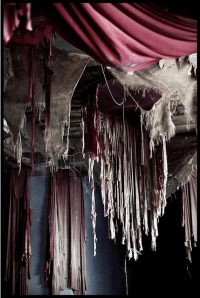
Click here for a Flickr slideshow of images of the Sofiensaal





 Indirect Routes