Category Archives: Thoughtful

Talking…it’s how EVERYTHING gets done

I have a small admission to make: I stink at small talk. Flop sweat, stammering, a too-loud laugh…you can watch me do ALL THREE if we’re strangers and you ask me a question. (It’s like a three ring circus for my personal insecurities. Where’s the cotton candy??)

The only time I’m really good at it is when my conversation partner stumbles (or strategically hits) upon one of my strengths or passions…when it doesn’t? Well, I’m as awkward as I was in junior high.

But – and here’s the thing – small talk is the very thing that invites larger conversations, that finds common ground. You have to be willing to expose personal parts of your life to make those connections…trying to seem too with-it, too professional will leave you with nothing to talk about except for your resume. But oversharing is also, obviously, a conversation-killer. (AWK-ward.)

Lifehacker has a good one-size-fits-all tip: share small details. Bringing up a topic that you’re passionate about, whether work-related, or concerned with affairs beyond the office walls (family! great restaurants! travel! books! youtube!), is an easy entry into a rewarding conversation. Because no one wants to spend all night talking platitudes…case studies are much more interesting.

Puttylike shares two other benchmarks that ring true to yours truly:

  1. We all want to connect with other people, but we just need to feel safe first.
  2. If you open up, others will, too.

Performers, you’re accustomed to putting yourself out there in every audition, every performance – to give a piece of yourself to any number of largely anonymous audition panels, audiences. You can do this!

As you’re vetting a new career, finding those points of entry can become even more crucial…advice, anecdotes, even connections for professional advancement can all lie in your ability to make connections. The good news? Is that you’re already fantastically equipped to do just that.

gaping voids, full of cartoons.

I’m a big fan of Hugh MacLeod. Have been for years. I get his daily email, that usually has a bright, graphic doodle (I hope that’s not an offensive term: it’s an abstract line drawing, to be less casual) that accompanies a strong thought or a pithy adage.

See, this is a career path that’s both creative and non-traditional. He took something that he enjoyed doing (i.e. writing modern-day adages) and used a medium that was infinitely accessible (pen & ink on the back of business cards).

Now, if you pitched that to someone:

“Hey. I’m going to draw cartoons on the back of business cards. And I’m going to share small snippets of real-life wisdom. And, on the backs of these tiny business cards, I’m going to build a MEDIA EMPIRE. Mwahahahaaaaaaaa!”

Yep. They’d likely ask the bartender to cut you off, and call you a cab.

But he did it. Because he realized that his art was accessible, and that there was a social component to what he wanted to do.

He’s an artist. But he didn’t spend years in the studio, working through academic crits, being graded refining his craft. He did those things while sitting at a pub, talking to people – there was a community aspect to what he did that integrated his love of the visual.

He found his sweet spot.

Do you have things that you’re passionate about, but that couldn’t possibly coexist in the same career?

And, are you willing to rethink that “couldn’t possibly coexist” clause?

Odds and Ends

I spent Monday home sick…it’s not often that I get my butt kicked sideways by a bug, but I’ve learned at this point that the absolute worst thing I can do is drag myself to the office on days like this: contaminating my space and my colleagues, feeling like crud, and usually getting little to no work of quality accomplished.

It’s a lose-lose situation, if you will.

So instead I napped on the couch, listened to the landscapers banter in Spanish as they planted three big ol’ Cypress trees in the yard, and started making my way through the unread items in my feed reader.

(As it turns out? I may in fact be in the running to star in Hoarders: Digital Media Edition. Yikes.)

But I did come across a few gems as pertains to the creative workforce:

  • What Recruiters Look For (via Lifehacker). They spend 6 seconds (! It makes a 16-bar audition slot look positively luxurious!) looking at your resume…best to make sure that those important things are easy to find…
  • Mentors. As creatives, we can all certainly name a specific teacher in our chosen discipline who served in that function. As you’re looking into something different, however, it’s as useful – perhaps even moreso – to find someone to help  you put your building blocks together in a  different way. And one of the points that Susan Adams makes that I love? You don’t have to have just one. There’s no competing-studio bias, no  teacher-centric cult-of-personality. (A refreshing thought, eh?)

And finally, this clip from John Cleese about creativity.  The clip I’ve posted is abbreviated, but Blurbomat has posted the entire lecture and it’s worth watching the whole way through. BrainPickings also pulls out several of the important points, so rather than reading my redundant ramblings, how about just taking a look-see?

Discernment, part deux

As I said before, I’m a sucker for a good to-do list. I have no fewer than 3 apps to keep track of grocery lists, t
I stumbled across this article by Kathy Caprino this evening. (The 8 Stages of Career Transformation.) And I can remember, so very vividly, going through this process when I was finally deciding to invest my time and efforts in a career that wasn’t performance-based. But I’ll disagree with the author in one fundamental way: I don’t think that it’s a linear process, and I think that often these steps happen simultaneously. For example, Disengagement from one’s present circumstances can – and I think often does – happen at the same time as Discovery, when you’re delving deeply to find those things that ring your bell, so to speak. o-do lists, bucket lists, and everything in between. Lists, structured steps, plans of action: all important things to me, and a real hindrance to any kind of free-lance career.

What do you think? Is the list complete? Would you add anything? And, if you’re seeking, do you recognize your place on this list?

Where the buck ($) stops.

Student loans.

We don’t like ’em.

Sure, we value what they enable: classes, guidance, a very special piece of paper that looks lovely framed on an office wall or teaching studio.

But be honest, how many of you really knew what you were signing up for by taking out those loans? Speaking personally, I knew very little, other than the fact that buying books and music (ok, and maybe dessert at Gullifty’s…that oreo cheesecake was my Achilles’ heel…) waited until that check hit my account. Rent, groceries, tights for dance class, parking fines…everything waited until the loan checks cleared and I was flush.

Fast forward many years and several jobs later. I am still paying off that oreo cheesecake, with interest, several times over. As a student looking at a job in law (or medicine, or other fields that require years of training,) there are examples -research – to give prospectives some idea of what they could earn as a professional. No guarantees, obviously, but at least they have an inkling of how many years it’ll take them to work their way out of their student loan debt.

Classical music? All bets are off. Undergraduate degrees. Master’s Degrees. Artist Diplomas. Young Artist programs. It’s a lot of expense, and a lot of debt on the shoulders of young artists, many of whom aren’t 100% sure that it’s their thing, or don’t really know what it actually entails. It’s difficult to dedicate yourself to an art form for which you spend as much time training as a physician, but earn less than the poverty standard. (And did I mention that your budget needs to include formalwear?)

The Times has an OpEd piece about some legislation that I think is largely overdue. Two senators have proposed disclosures about student loans, the different types that exist, and how to prioritize. I think it’s a good small step towards educating families and students about debt: but there needs to be another step for performing arts students (and studies like SNAAP are starting this part of the conversation) where they are given a realistic view of the lifestyle and the financial realities.

Come clean – are you still paying off your student loans?

Charisma

As performers (and, perhaps more truthfully, auditioners), we all have ideas about the image that we project.

We’ve been coached by teachers that our audition begins before we even set foot in the room. We know that, in order to give our best audition that we need to be fully prepared. We know that it’s our job to make a connection with the panel somehow, and that, more importantly, that connection needs to be positive.

We visualize walking into the audition room: entering with confidence, greeting the panel, discussing rep with the pianist. We visualize how that first piece will go, how that wild-card second piece (because they will naturally ask for it) will somehow be even better than the first. We see ourselves leaving the room feeling good about our performance, the reactions of the panel, and our future prospects. We know that running through that scene in our heads and filing it with positive value will help us give stronger auditions.

And even though our hearts may be busted if we don’t get the job, we know that that impression that we’ve made on the panel will follow us, making things easier or harder in subsequent auditions. It’s the reason we celebrate a good audition in addition to a job offer: because the audition is important; and the way we present ourselves, personally and artistically, is as important in the audition room as it is onstage.

These visualization techniques are one of the Jedi mind tricks that author Olivia Fox Cabane cites as a way to improve one’s charisma. In an interview for Fast Company, she talked about the several types of charisma that exist  (focus; visionary; authority; kindness), and how one might cultivate those characteristics. (I for one was pretty excited to find that introverts can excel at developing focus charisma, as it calls for blocking out everything save for the person with whom you’re talking.) She talks about the ways in which charisma is essential for building businesses.

And I have to say that, of the performers I know? Well, y’all are not close to being short on charisma.

Take this as just one skill that, while it might not show up on your resume proper, will help you through this professional journey.

Discernment

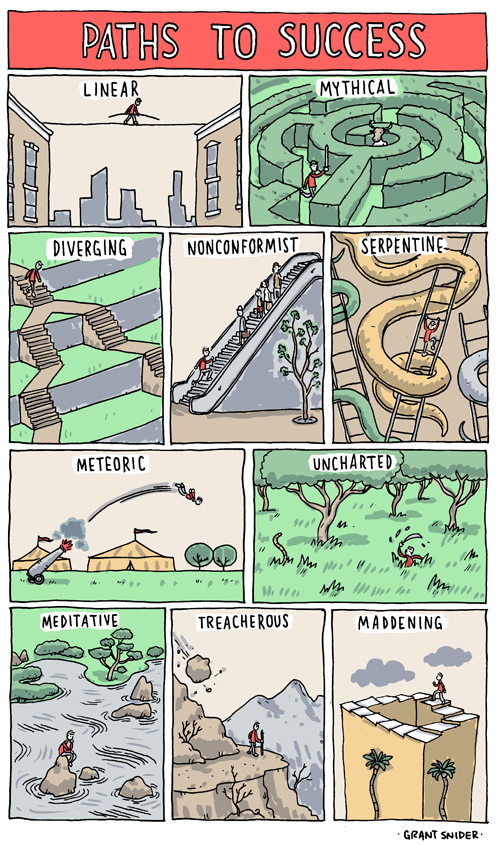
I’m a sucker for to-do lists, and maps to get from point A to point C in the most efficient manner.(Looking back on my own path, it’s part of the reason why classical music appealed so much to me: there was a seemingly tangible, organized trajectory to get from music student to professional opera singer. When that started to not quite be the case, well, part of the attraction fizzled.)  But, as I’m learning (yes folks! SHE CAN BE TAUGHT!), a pre-prescribed path doesn’t work for very many of us. It’s easy to be reactionary, to make a choice – or a whole series of choices – based on external factors: what I should do, what pays the most, what my family will have the most respect for…the list goes on.

But it’s difficult to talk about discernment.

We struggle to talk about feeling unfulfilled (especially when family and friends are supportive of our talents), we worry that talking to people about wanting to change careers could hamstring us if we ultimately decide that performing is our thing. We struggle to find the time and space to soul-search, to ask questions and really listen to the answers. And we look at our resumes and wonder if we’d ever be able to make a transition, even if we wanted to, with the plethora of stage credits and comparable lack of office/teaching/business experience.

It’s an extremely personal process.

And, like most large projects, it’s better divvied up into small chunks. (One of the beautiful things that tends to hamper we creative folks is that we rush right to the end result in our heads, and decide whether or not it’s going to work before we’ve even begun the journey. Or maybe that’s just me?)

This article very quickly combined my love of lists with a succinct small step/big question discernment exercise. Three steps, maybe thirty minutes of your time.

  1. What do you want?
  2. Dive into why you want it.
  3. Gain information and momentum.

Even if you end up with more questions than you started with, you’ve at least started the process, right?

Tagged ,

Monday musings -classical singing edition

I’ve been thinking, maybe a little more than I should, about the education of singers.

Now, I’m far from the first person to think that undergraduates are underexposed to the realities of making a living in this field: the advanced degrees needed, and the corresponding debt. The fiscal realities of a freelance career. The inherent biases in the industry. The challenges to sustaining healthy support systems. The tricky nature of telling your non-industry significant other that you need to kiss someone else ‘professionally.'(Several times. For practice.) The inevitable reality that, even though you’re not making enough money to both pay your student loans and live, you still need to file and pay taxes on all of those 1099s.

And, while I realize that the collegiate programs need to educate the students as to how to be artists, I feel that they have a responsibility to also let these fledgling artists know what they can expect upon graduation.

Let’s face it: a student entering law school or medical school can guesstimate their income post-graduation, assuming everything goes well. But singers are shown examples of those who have succeeded, those with big contracts, with some earning heft. They’re not shown the adjunct faculty member who is toiling at their craft and producing the next generation of artists, but is earning at or below the poverty level…the freelancer whose medical condition necessitated a ‘real job’ and the corresponding insurance…the performer whose personal life disintegrated over a showmance. Or, when these ancillary stories are told, they’re framed as cautionary tales…”don’t let this happen to you, kids. Work hard, make art, live your dream!”

I submit for your approval the ideas that conservatories should be choosier…that artists should be given tools for both art and life…and that opting out of a performance career is not something of which anyone should be ashamed.

Discuss.