Many happy returns

The Opera America conference was a whirlwind of faces and topics and information that was, quite frankly, a lot to digest. I’m still processing most of it, I have to admit. But spending several days talking about Creative Resurgence and the ways in which people and industries reinvent themselves has my mental hamster on the ol’ exercise wheel in a significant way.

The model for opera in the US is changing – not many would dispute that. Companies are folding, chamber opera is being championed (a lovely thing for my own venue) to an extraordinary degree, and there’s a serious push towards adding to the American operatic canon…all these are part of the changing landscape. But I’d argue that there’s a huge swath of singers that are struggling with these changes…there’s a group of fantastically talenter singers who aren’t young artists, but who also aren’t Terfel or DiDonato or one of the handful of singers with name recognition, who are being squeezed out by economics. (In a related comic turn, a baritone for whom I have a great deal of respect and adoration – and who falls squarely in the Working category –  has a black biography on his website…in beautiful marketing-speak, and in his case belying his significant career.)

The big take-away that I find from many of these discussions is that our educational institutions must find a way (and I realize, budgets and time hardly allow for the learning as it currently stands) to not only help students discern their skills outside of vocalism but also help them figure out how they might leverage said skills into careers…onstage or off. As the field becomes more entrepreneurial, so must both the artists and the institutions that train them.

Specific reflections on the conference coming soon, as well as thoughts on the role of higher education in the process… this topic warrants many (happy) returns.

Tagged , , , , , , , , ,

Out of Office

Posting will be light (read: likely non-existent) this week, as I’ve been selected as one of the participants of Opera America’s inaugural Leadership Seminar. The festivities kick off at the yearly conference this week in Philadelphia, with big days of seminars, meetings, and performances. The main thrust of the conference is Creative Resurgence, a theme that I think meshes quite nicely with this little corner of the internet: I’m looking forward to sharing stories with you all upon my return.


Celebrate the Mess!

I am such a fan of people’s stories.

A huge fan. And not just of the final product, but of the whole ongoing process: the passion, the struggles, the discernment, the adventure of a new path, the satisfaction of recommitting to a routine or activity that brings comfort. But I’m finding that folks often apologize for the process…for leaving their original passion, for floundering before finding the new avenue.

Quite frankly? Those messy moments are so very telling. I am also a HUGE fan of those creative messes.

I remember being called into a meeting at my HVAC job, where my bosses quite generously offered me an opportunity to advance to their sales team. I had no real knowledge of the business, had a limited background in the science and technology behind the product, and while I enjoyed the office and the challenge of educating myself about widgets and airflow and humidity (and also learning to RTFM) I was pretty sure that I didn’t belong there. But I really didn’t know what I wanted to do…so I stammered my way out of the meeting, letting them know how flattered I was to be considered. I slept on it, and shortly thereafter tendered my resignation to finish my teaching certificate.

It was a messy situation, a snap decision, but ultimately it was the right thing.

Do I regret my widget days? Not at all – I learned how to function in a linear, masculine office, figure things out on my own before asking (and to also not be ashamed when I needed to ask), and speak my mind plainly and clearly. But I also didn’t realize that my (wholly unformed)dreams didn’t jive with my circumstance until my bosses showed a willingness to invest in me.  It was a catalyst, a get-off-your-butt-and-make-a-choice moment.

I’ve referenced Danielle LaPorte before, but this posting is a theme that I think bears repeating:

You don’t need to burn the dock to push off your boat.

You don’t need to dis’ how you’ve done things in order to do things differently.

There’s no need to criticize the past to validate the future.

But we do.

She goes on to say that honoring the path that got us to -or even past – the messy part is a vital part of our own story. And I would heartily agree.

Celebrate the mess, my friends!

Tagged , , , , , ,

Stephen Brody: Scheduling Solutions

Since my head is still very much wrapped around Marci Alboher’s book and the concept of “slash careers”, today’s profile is of a singer/web designer. I met Brody in a pal’s office at the University of Maryland several years ago, and he approached us a few years later with a great idea for a scheduling program that’s in beta testing now and will undoubtably make my former administrative interns weep at the thought of all of their lost hours, proofing excel spreadsheets for typos and double-bookings. Here’s his story:

Where did you go to school?
I received a Bachelor of Music degree in Vocal Performance from Loyola University of New Orleans and a Master of Music degree in Opera Performance from the University of Maryland Opera Studio.

Did you want always want to be an opera singer when you grew up?
I grew up wanting to work for NASA. It was my dream as a kid to become an astronaut, and as I grew older I wanted to work in design and development for NASA in Houston, TX – where I grew up.  I was accepted into the College of Engineering at Texas A&M.

Huh! How did you get to opera from there?
In February of 2003, a week after I had been accepted to A&M, my voice teacher called me and my parents into her office. She wanted me to take a year to study music and recommended a baritone named Philip Frohnmayer  who was on the faculty at Loyola University of New Orleans. I was very hesitant and uneasy about the idea – after all, I had spent my entire life wanting to study Aerospace and Mechanical engineering at Texas A&M and actually got in! Texas A&M allowed me to defer a year and my parents convinced me to head down a few weeks later to audition. I figured taking a year off to sing and live in New Orleans would be fun! A month or so later I was accepted as a Vocal Performance major and in the fall I made my way down to the Crescent City to begin my music studies.

The second defining moment came the summer between my junior and senior year in undergrad. I remember the moment precisely; I was sitting in a rehearsal for Il barbiere di Siviglia at Opera in the Ozarks in 2006. I was double cast as Basilio and we were rehearsing the Act 1 finale. I was sitting in the audience studying my score as I watched my colleagues on stage and it was at that moment, that I realized I wanted to be an opera singer for the rest of my life. I loved the rehearsal process, the people, the travel and the craziness & hard work involved in bringing a character to life.

What is your current profession?
I am an opera singer by profession and a web consultant by trade. I think a better title would be ‘operapreneur.’

How does the web consultant piece fit into your operatic path?
I have never stopped performing but over the past five years or so I have embarked on two career paths simultaneously – both dependent on each other. My web design business grew out of friends and colleagues needing websites for themselves, the luxury for me was that everywhere I performed, I was introduced to new prospective clients! Web design became the perfect opportunity for me to fund my opera career without having to get a “real job.”

It has been a very gradual process. I knew even as a student at Loyola that, if I was going to be an opera singer, I was going to need a website to market myself. I didn’t have the money for a custom site and I hated the idea of cheap “cookie cutter” websites – so I set out to build my own.  I am almost entirely self taught as a designer and developer. Everything that I have learned about web design, development and marketing has come through trial & error.

I haven’t opted out of singing, but there have been some major positives and negatives along the way. In 2010, I took most of the year off to concentrate on my finances. I had been hired by a web agency in Bethesda, MD as a web designer with a nice salary, benefits and the like. They were a fantastic company, I learned an immense amount about the web business while I was there and they even let me leave for over a month to perform with Opera Fairbanks in Alaska that summer. While I was working full time, I realized that I was not cut out for a normal 9-5 job; the creativity that I thrived on was stifled by managers and stubborn, “old-school” developers unwilling to embrace new technology and design styles. I longed for my weekly voice lessons and time spent in rehearsals. I hadn’t learned any new music (aside from Masetto for Opera Fairbanks) and found it was increasingly difficult to concentrate on musical matters. A few weeks before the New York audition season began, we decided to part ways.

But you said that you were a web consultant by trade – are you still working in tech at all?
I am! Today, I am the CEO & Co-founder of Schedule Arts LLC. Andrew Lunsford (a tenor whom I met while we were singing with Opera New Jersey) is the President & Co-founder, and together we have developed a web based production scheduling application for arts companies. Our program reduces the time and money required for an arts organization to create and distribute their daily, weekly and monthly production schedules by 50% or more. We provide sophisticated conflict detection to prevent inadvertent double bookings, individual schedules so artists and staff don’t have to search through a maze of rehearsals to figure out their schedule, online request forms to easily organize & manage releases, coachings and rehearsals, along with many more features to reduce the time and stress associated with the production schedule. And it all came out of our mutual frustration with being double-booked for coachings and staging rehearsals!

Did your musical training come in handy in managing your two (very different) career paths?
My careers as both an opera singer and web consultant go hand in hand. My ability to communicate on stage has helped me better communicate with my clients offstage. I am able to calmly work with all sorts of people and create designs that break the mold from the “classical singer” website.

Was there a certain person who directly or indirectly influenced your decision?
Laura Lee Everett has been my cornerstone these past couple of  years. From day one at the Maryland Opera Studio, she worked hard to support me on stage and off. Laura Lee has helped guide both of my careers; providing me with constant advice, testing out my ideas, keeping me focused, and introducing me to invaluable colleagues and contacts. She convinced me to exhibit as a web consultant at the Opera America Convention in 2009 which opened the door for me as an operapreneur and has been an incredible influence with Schedule Arts.

Any advice to share?
My voice teacher in undergrad, Philip Frohnmayer, gave me the best advice; he said, “Brody, the most important thing in this industry is perseverance, to continue on regardless of how hard it gets.” I have never forgotten those words. They have helped me make it through countless 100+ hour work weeks, times where I thought I wouldn’t be hired for any opera, and the hardest times when I’m torn between leaving opera behind or pushing forward. My advice is to always try everything at least once and keep pushing forward – If I hadn’t, I’d probably be back in Texas at Johnson Space Center living a “normal” life. It sounds cliche, but I wouldn’t change a thing. Sure I would like to have been more prepared for some of my rehearsals or to concentrate a little more on my opera career. My path has been a roller coaster and the random twists and turns have led me to a very bright future – I couldn’t ask for anything more!

Brody will be at the Opera America Conference in Philadelphia next week, unveiling a beta version of the Schedule Arts scheduling program. I hope you’ll join me in checking it out!

Tagged , , , , ,

Reading List: One Person/Multiple Careers

My friend Claire (she is my new go-to for great books – her mom is a librarian, and she’s supremely well-read.) turned me on to Marci Alboher‘s book One Person/Multiple Careers: A New Model for Work/Life Success.

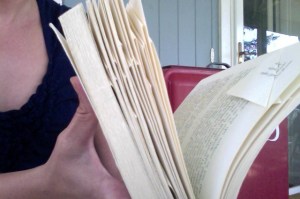
Now, I’m not usually a highlighter of books: when I find something interesting, I’ll either stick a piece of paper (gas receipt, junk mail, business cards…even twist-ties and rubber band serve on occasion) in the pages of a hardcover, or, if the book is mine and a paperback, I’ll dog-ear the page. (Book purists, I apologize.) So I took the book to the gym, to motor through some reading while on the elliptical.

Here’s what the poor, poor book looked like after an hour:

You can tell that I’m finding a lot of value in this particular tome. I’m tempted to just copy all of the bits and pieces that ring true to me, but we’d be here all bloomin’ day.

The most liberating takeaway is one that flies in direct opposition to what many of us have been taught: the concept that we don’t actually need to specialize for a lifetime in one discipline and ignore everything else that we enjoy in order to find success. For some people there are parallel tracks; others commit to a discipline for a number of months/years, and then either leverage that knowledge or skill set into a different career or turn that single-minded focus towards another discipline that they’re interested in. But all of the permutations are valid, and frankly very interesting. And it’s not much of a surprise to see a high number of artists and musicians’ stories represented within the pages.

There are strategies for finding your ‘slash’ (or, rather ‘slashes’ – why stop at one?), interspersed with real-life case studies of folks who have successfully explored both parallel and sequential tracks.

It’s worth the read, I promise! (And thanks, Claire, for the recommendation!)

Tagged , , , , , , , , ,

Being Awesome.

How can anyone ignore a presentation titled “Stop Sucking and Be Awesome Instead”?

Yeah, I don’t know, either. This presentation is for the code-conversant among us, but there are so many great points raised that the discipline is less relevant than the message.

1. Embrace the suck.
2. Do it in public.
3. Pick stuff that matters.

You are never too young/old to admit that there are things that don’t come easy to you…I can think of several that pertain to me just off the top of my head (anxious; highly distract-able; subject to verbal diarrhea; all come to mind), and the folks who work with me likely have a whole other list of ways in which I should Get My Act Together.

I get it. I’m not, and may never be, a finished product. And that’s ok. I strive to be open about my shortcomings… I don’t have a carefully crafted public persona… and I choose to spend my time helping folks and an art form that, frankly, I feel honored to support.

(I subscribe to the maxims above, obviously.)

But I think it’s telling that, in her May 2012 address to the Harvard Business School, Sheryl Sandberg (Facebook’s COO) talks about knowing – and addressing – those things that she struggles with:

One trick I’ve discovered is that I try to speak really openly about the things I’m bad at, because that gives people permission to agree with me, which is a lot easier than pointing it out in the first place. To take one of many possible examples, when things are unresolved I can get a tad anxious. Really, when anything’s unresolved, I get anxious. I’m quite certain no one has accused me of being too calm. So I speak about it openly and that gives people permission to tell me when it’s happening. But if I never said anything, would anyone who works at Facebook walk up to me and say, “Hey Sheryl, calm down. You’re driving us all nuts!” I don’t think so.

Transparency… Self-knowledge… Broaching the tough subject… the elephant in the room… These are all things that we deal with as artists on a daily, consistent basis.

Tagged , , ,

Vic Muenzer- Language and Sound

I spend 4 intense days each year with Vic, in a small, windowless room, with 3 other guys…sounds sordid, but on the contrary our only vices are the great cookies from Shirlington’s Best Buns bakery! We get together to  produce Wolf Trap‘s classical radio show, Center Stage from Wolf Trap. Vic is our producer and distributor, but he’s also a conductor… with a degree in …English? Here’s Vic’s story.

How did you get started?

I had wanted to go to Northern Illinois as a music major.  My father discouraged me early on after I studied violin with him, saying I had no ear.  Also, both parents felt that Northwestern was a much better school. (My mother was a NU alum, and my father was on the faculty at Northwestern, so we were entitled to get half off tuition.  That discount certainly helped direct my decision). I played piano, but I didn’t really want to be a piano major, and wasn’t up to the NU performance standards, and in all honesty I was more interested in recording.

I had just come off of a successful year in AP English (at Maine South H.S.) and coincidentally English was the most flexible undergraduate major at Northwestern.  So I had my cake and ate it too – I was an English major, but did every course a music major would have done except the performance requirement.  I graduated with a B.A. in English.

There were not many places one could go to learn the art of classical recording, but Northwestern turned out to be an ideal place.  Pick-Staiger Concert Hall had just been built and it had a new recording studio with no one to run it, so I was able to come in on the ground floor and learn by doing.  In retrospect it was a great opportunity.  By the time I had left NU I had produced 3 commercial recordings.

(Editor: Vic had a very specific experience that drew him to the art of recording, and wrote about it. It’s a beautiful essay, and one that I wouldn’t tinker with. You can find it at the end of this post.) 

So, the recording thing really started to pan out for you even before you graduated…

Truly.  Since the event that is described in the essay, I began regularly attending recording sessions with the Chicago Symphony Orchestra (I could because I was family) and I ended up befriending nearly every recording team that came through Chicago – from Decca to DG and RCA.

Also, at Northwestern whenever I produced a recording for someone,  positive feedback kept coming back to me.  The feedback that made perhaps the biggest impression on me was when the first violinist of the Fine Arts Quartet took me aside at the end of a session and told me I was quite good at producing and that I should pursue it as a career.

So, you self-define as a recording engineer?

Well…not so much. I am a radio producer and a conductor.  (Now there’s a combo)

Whoa! Ok, how did you get from point A to point…Q?

I continued to build a career as a record producer until the mid nineties.  In 1997 I left the record business:  after three years of producing for Daniel Barenboim, our company lost the contract to produce his records.  This led to many different efforts to save the company, one of which was a contract to produce “wholly owned” orchestra recordings for a company called NorthSound which provided classical music laced with nature sounds, which they sold in kiosks at museum stores and tourist shops.  This contract, ironically, led to my first conducting efforts, as it was cheaper to conduct myself than hire a conductor for the purposes of many of the NorthSound recording sessions.

In keeping my hand on the technical side, I also began producing radio shows. (Editor – This is the role in which I first met Vic.)

So now? I am a radio producer.   I am a “retired” record producer.   I am a conductor.   I am a mediocre trumpet player.   (haha)

So how did your training inform your path to your current profession? 

I have found that everything has fed into everything else.  Performance and musical studies have made me stronger as a record producer and subsequently a radio producer.  And my experiences working with top-notch conductors as a record producer have made me a much better musician and conductor. Northwestern did provide me with some big opportunities.  I probably got my big break when Cablevision came to Northwestern to do a pilot live performing arts show for a new concept called Bravo.  (Working on that pilot at Pick Staiger led to my becoming the first Associate Producer of the Bravo Network!) And, something I couldn’t have anticipated, but being an English major from Northwestern has really enhanced my abilities as a radio producer, because most of what I do revolves around the verbal presentation of the “stories behind the music”.  So research, writing skills, verbal communication and syntax are highly integral to my radio work in a way I would never have anticipated.   So the English major turned out to be important.

Lesson: Everything in life has value…eventually.  We learn from EVERYTHING!

I will wholeheartedly agree with that statement. So, what advice do you have for folks who are searching?

First of all, get to know yourself well enough that you can be honest with yourself. Then, look into your heart, listen to it, and follow it.  Determine what your true priorities are in life and build everything around that.

Thanks, Vic. Here’s his essay, Reverberations of a Ruin.

The images are eerie, even maudlin: the odd remains of a building built in 1826. The facade still stands, as do the side walls of the long building. Those two-story longitudinal walls remain filled with rows of window-like balconies, dusted with ornate Rococo filigree, partially melted by flame. The plaster handiwork of many nineteenth century artisans is evident everywhere. My eyes starve to see more. They strain to look deeper into the photos, and I move closer as if that could in some way let me see more. Macabre graffiti, the work of some very different twenty-first century artisans, covers many of the nineteenth century creations. Disturbing though the graffiti is, its oddly appropriate to the ruin. At least its an indication that life still passes through. The hallways to the great ballroom remain standing in defiance of time. The velvet red fabric that lined the ceilings of those hallways hangs in shreds like some great bleeding weep.

At my home in Chicago, on my laptop, with my wireless, I stare into the screen obsessed by these pictures that some creative photographer posted on the web. I thank him. The building—or the remains of the building—lay on Marxergasse in the third district of the Landstrasse district of Vienna. The computer I stare into is 4,700 miles away from Marxergasse. Yet these images throw knives into my heart. It is as if I am there. These pictures are burned into the very depths of my soul. In the bottom of the old building was a pool almost the full size of the foundation footprint. It lay under the grand parquet dance floor of the grand ballroom. The Sofiensaal started life as a public bath house in the 1820s. Soon though, the pool was covered over with a dance floor when the owners figured out that the society of Johann Strauss, father and son, preferred dancing over public bathing. Silly Austrians they must have been. But they knew what they wanted for the hall became a favored Viennese dancing spot, and those Strauss waltz-kings graced the Sofiensaal with their music for decades.

With the grand parquet dance floor now burnt and disintegrated, the pool is again clearly visible in the wreckage and a charred grand piano came to rest in its depths, a legacy of the last recording—a piano recording—made in the Sofiensaal, before fire took the building in August of 2001. The great wooden vaulted roof that covered the ballroom is gone. Lit now by bright yellow sunlight, the image of the piano perched in the empty pool is stark. With what remains now open to the elements, this picture lays bare the mystical core of the Sofiensaals greatness: that pool.

The Sofiensal was the place of dreams. It was where dreams were…well…made into permanent dreams, and then committed to funny little grooves etched in vinyl. It was where my dreams were made permanent. You see, my career leads directly back to that old building. And the pool is the key to it all.

When the pool was parqueted over, it was destined to be discovered as one of the greatest recording studio acoustics in the world with unbelievable warmth and bass response, combined with incredible immediacy. The mysterious pool that lay under the beautiful dance floor was the reason. With the parquet floor built over it, that pool resonated and grooved to the sounds of Wagner, Strauss, Beethoven, Verdi and Mozart.

The hall was so good that in 1956 the English record company Decca moved in and used it as their principle European recording facility for the next twenty-five years. The recordings made there are legendary and stand to this day as the greatest achievements in the history of recorded sound. The Decca producer who guided this effort was John Culshaw. With him was a legendary recording team who pioneered many recording techniques in use today on classical recording sessions and film scoring stages. Culshaw was not interested in reproducing the reality of the live performance. His purpose was to create a listening experience wholly unique to the gramophone. It was bigger, more intimate, more detailed, and had more impact than anything you could expect to hear live. Every opera recording was literally “staged” for the microphones. There were effects used in his recordings that were rarely possible in actual performance. He created recordings in the Sofiensaal that were so hyper-real, so much bigger than life, that they demanded to be heard. He did it this way because he knew that you, the listener, would listen to these recordings over and over, precisely because they were bigger than life.

Indeed, many recordings made in the Sofiensaal became definitive of the art. Wagners Ring Cycle conceived by Culshaw within the walls of the Sofiensaal, recorded with a young Hungarian exiled conductor known as Georg Solti and the Vienna Philharmonic along with all the greatest singing talent available at the time, is simply known as the “Solti Ring.” The fifteen hour recording took seven years to make. To this day, it is considered the greatest achievement in the history of music recording and still supersedes all versions that followed. It does so not just on the strength of its cast or the brilliant leadership of Solti, both of which are formidable to be sure, but because the creativity with which the recording itself is conceived has never been matched. In that era, video was impossible for the consumer, so the recording had to be so vivid that it created visuals in your imagination. Indeed, Culshaw and Solti collaborated to create a “theatre of the mind” in recorded sound. They staged the operas in your mind. Culshaw didnt need video. He didnt make recordings, he crafted them. He loved doing it. And the Sofiensaal was his playground.

I knew about the Sofiensal when I was young. We had the Solti Ring at home. I listened to the whole thing many times, likely one of the few eleven year olds in Chicago to do such a looney thing. But I got it big time, the whole shebang: Wagner, Solti, The Ring, Birgit Nilsson, Gustav Neidlinger, Wolfgang Windgassen, Hans Hotter, Brunnhilde, Alberich, Siegfried, Wotan. But most of all I got John Culshaw. Even at eleven, I knew what Culshaw had done was special, it was something different. Having a father in the Chicago Symphony Orchestra, an orchestra that recently had the foresight to hire Georg Solti as its music director, it was inevitable that I was closer to the classical recording scene than most. Already, there was the tremendous legacy of Fritz Reiner and his recordings with the CSO on RCA. But at thirteen, I was unprepared for the privilege that would soon be mine.

In September of 1971 the CSO was to tour Europe for six weeks. For whatever reason I got to go along. The first week was to be in Vienna and the orchestra was recording the Mahler Symphony No. 8 at the Sofiensaal. I was there running around that recording session. I sat in a special sound control room. John Culshaw was there in spirit, if not in fact (He had left Decca by then, but I swear I remember him in the control room that day). Where I sat, a second Decca team experimented with quadraphonic sound in a room separate from the main control room, as the huge Mahler Symphony was recorded. They built enormous grandstands that stood beside the two stories of decorated balconies in the Sofiensaal. These bleachers accommodated two full choruses and the Vienna Boys Choir. In front of them were 7 soloists and a Chicago Symphony augmented to 120 for the occasion. All these forces were driven by Sir Georg Solti, as one would drive the finest Ferrari in the world. I imagined the glee on Culshaws face as the team played with the four speaker mix for the experimental quadraphonic sound. It was an effort, once again, to take recorded music to a level beyond that of live performance, so that you would want to buy it and listen to it over and over. John knew what he was doing. He defined an industry. Some of the opera recordings he made in the Sofiensaal outsold the pop recordings of the time, to the chagrin of Deccas competitors. In those two days, that smile, the power of the Mahler 8th, the unswerving musical genius of Georg Solti and the glorious sound of the Sofiensaal—that converted bathhouse, that Vienna party room turned recording studio —it all got to me. That day set my path. I was to be a record producer, a classical record producer, creating big productions like that. And I made it. I made it because of the Sofiensaal and Solti and Culshaw and the Ring and the Mahler 8th. In a day, a life was set. Those elements instilled in me an ethic of what making a recording was all about. Without those experiences, I would not have been the same, nor would I have had my career.

I stare now into the pictures, the bare hallways of the remains of the Sofiensaal, looking for signs of what once must have been the great control rooms that Decca created. I struggle to figure out which doors I must have used to get from the soundstage built in the great ballroom back to the control rooms. I look for signs of the adjacent Blauer Ballroom which the Decca engineers used as their reverberation room, as they did not have the digital reverb units with digitally reproduced concert halls that we have now. I stare hard at the close-up photos of the ornate plasterwork fragments that remain, and imagine the sound waves of the Chicago Symphony and the Vienna Philharmonic bouncing around among all that wood and plaster. I imagine in my mind a day when musicians and engineers collaborated on an ideal: the “theatre of the mind”. Nothing stopped them from making the most perfect, exciting, dramatic recording they could, to be preserved for all time, and for all to enjoy. The Sofiensaal was a place where reality checked itself at the door. Inside that old bathhouse, indeed, dreams were made.

So I stare again at those photos on my computer screen, searching intently for signs of those dreams, of that creative ideal, of the ghosts of Solti, Culshaw, Nilsson, Windgassen, Neidlinger, Fisher-Dieskau, the Decca Recording team, the Vienna Philharmonic, and the Chicago Symphony who graced the acoustics of the Sofiensaal with its own glorious sound on three occasions. I look for signs of my own, however brief, presence. Honestly, I have to squint, struggling to reconcile the ruins with my memory. Yet I know in my heart that the Sofiensaal is alive with music, but not in those pictures. The Sofiensaal itself resonates no longer. But it will always resonate in my soul. I am grateful for what it gave me, and for that which it gave the world. The recorded legacy of the Sofiensaal still exists even if the building and the people who created that legacy do not. I celebrate the ruin of the Sofiensaal, even as it brings tears to my eyes. I look at my kids and wonder. What will be their “Sofiensaal”?
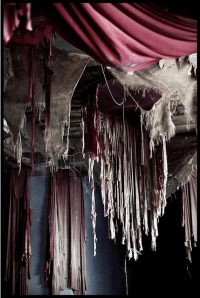
Click here for a Flickr slideshow of images of the Sofiensaal

Tagged , , , , , ,

Contrasts

One of the great things about school in the arts is that, at an amazingly impressionable and optimistic age, we’re suddenly surrounded with people interested in the same things were are – but who often have wildly different backgrounds and preferences. Conversations can traverse light years, bouncing from pop culture to Nietzsche to a musical theater melody to dreams to memories to expectations in mere minutes. We’re consuming information and putting it together almost as nimbly as we did as small children…navigating the way our worlds worked, learning how to communicate. And the more disparate influences we have? The more interesting our projects become.

I find myself nowadays using that interest in a million things to multitask just to get the mundane things completed. Work, laundry, feeding myself and my family and making sure All Of The Things get done. Creative? Only in the ways I save a few pennies or streamline my errand running or trips up the stairs. (Yawn. I might’ve just bored myself to sleep.) So I’m drawn to this graphic note by Nick Cave.

I started googling the names I didn’t know (and I’ll be honest, I have many many more to go) and wondering whether the smudges were made by condensation from a glass? Tears seem too sentimental, but maybe?

I’ll be honest, I thought that I was going to contrast this idea with this OpEd piece in the Times written by David Byrne’s daughter Malu, a glass sculptor (!) and jewelry maker. She writes about needing to leave the city to really access her creativity. And I thought here! Here is an example of conflicting advice! The constant barrage of cross-pollination versus quiet inspiration. Genius!

But that wasn’t so much the focus of her writing.

She says that in the city there are too many distractions; the amount of non-creative work needed to sustain an artistic lifestyle; the cramped spaces; and the constant stimulus allow for very little time for reflection or incorporation. She is seeking out a new area from which to create, to find her individual voice.

So, she’s not running away from the connections, but is running to find a space in which to process them…in which she can actually create.

A crowded page. A bucolic landscape. Why not both?

Tagged , , , , , , ,

Tips from the Lectern

The number of great, inspiring graduation addresses that hit the web every spring always leave me feeling a little more excited for the future, a little happier with my personal vantage point, and eager for the new graduates to inject some life into our daily workings. (My strange love of a good commencement speech is a little less creepy when you realize that my summer work force is largely composed of these bright young minds.)

Have you seen Neil Gaiman‘s address for the University of the Arts commencement ceremonies?

Because if you haven’t? It’s worth it. Gems of wisdom for the newly-minted creatives among us. Here’s one pearl:

Looking back, I’ve had a remarkable ride. I’m not sure I can call it a career, because a career implies that I had some kind of career plan, and I never did. The nearest thing I had was a list I made when I was 15 of everything I wanted to do: to write an adult novel, a children’s book, a comic, a movie, record an audiobook, write an episode of Doctor Who… and so on. I didn’t have a career. I just did the next thing on the list.

Kim Pensinger Witman‘s post from a few weeks back touches on a similar theme, of thinking of the next exciting step, rather than trying to “do” the whole career at once. And while Mr. Gaiman does talk about having a idea of what he wanted to become, his “mountain,” he also speaks about the flexibility and choices that he made in order to get closer to that less-direct, slightly fuzzy goal. (I’ll tie some of this in with a review of Marci Alboher‘s One Person/Multiple Careers in the next week or so.)

He also has a few valuable snippets for freelancers, points that currently ring quite true in the arts community:

People keep working, in a freelance world, and more and more of today’s world is freelance, because their work is good, and because they are easy to get along with, and because they deliver the work on time. And you don’t even need all three. Two out of three is fine. People will tolerate how unpleasant you are if your work is good and you deliver it on time. They’ll forgive the lateness of the work if it’s good, and if they like you. And you don’t have to be as good as the others if you’re on time and it’s always a pleasure to hear from you.

Be prepared. Be flexible. Be nice. A good professional mantra, even if you’re not quite sure what exactly you want to be when you grow up.

Tagged , , , , , , , , , ,