Critical mass.

The beginning of the summer season has totally thrown my publishing schedule for a loop, and I apologize. But I do have things to share with you, and will be back to semi-regular publishing after the Memorial Day holiday. Please check back!

Wishing you all a weekend of lovely weather, relaxation, icy beverages and grilled tastiness.

On smugness, searching, and self-reliance.

20120520-070705.jpg

There’s a lot of advice about following your dreams and loving what you do.

I think it mostly comes from an empowering place…spending 40+hours something you enjoy can only enrich your life, your relationships, right? For those of us who have lucked into/sacrificed for/found one of those jobs, it seems pretty smug to preach about the importance of adoring your professional life. I mean, who wants to spend their workweek doing something that they hate? Um, nobody. Even if the perks or money are compelling for a while, sooner or later an exit strategy is developed, a parachute is crafted, and a departure is engineered.

However, doing that thing that we love can come with some serious baggage in the form of financial hardship. Student loans, a rough (to be generous) job market…if you’re in the arts, you’ll also factor in the cost of living, which will likely be on the high side since metropolitan areas are usually the places where culture thrives. (Not always, for sure…and there’s something wonderful to be said for those communities who embrace art-makers as an integral part of their fabric.)

So, how to reconcile following the career that makes your heart sing while also being able to live? And really, to live, not just survive?

Million-dollar question, that.

I came across this quote:

…The first step is creating a foundation of self-reliance: a survival dance of integrity that allows you to be in the world in a good way—a way that is psychologically sustaining, economically adequate, socially responsible, and environmentally sound.

I think it’s absolutely true that you cannot make your best art, or your best effort, when you’re not feeling safe. There’s a reason that the trappings of security are the foundation of Maslow’s pyramid: if our basic needs aren’t met, we can’t function strongly in society…we can’t contribute creatively if we can’t feed ourselves!

But, and here’s the bigger question: Do we dive in and hope for the best? (We are artists, after all…there’s a certain amount of grace for those who make beauty for a living, I think.) Do we defer the dream for security? How do we find a balance, find that self-reliance?

There are some great stories on this site of folks who have found that balance…and they’ve done it in as many different ways as there are people profiled. If you have a similar story, I’d love to hear it- you can find me in the comments here, or at indirectroutes@gmail.com.

Tagged , , , , ,

Career Scaffolding

Rather than posting a personal profile this week, I’d like to direct you towards a post on Creative Infrastructure by Linda Essig, the director of ASU’s Arts Entrepreneurship Program.

(Side note – Arts Entrepreneurship? How awesome is that? While the 17-year-old-Me might’ve been all about performing, the [mumblemumble]-something Me is totally entranced by this program of study.)

She writes, in reference to a chance meeting with an arts worker in a metropolitan sushi bar:

The story of J is a good example of a person who uses his talents, skill and training in the arts to build a career, albeit not one he would have envisioned as an art student. Students enter study in the arts with many dreams and aspirations. […] If J had kept his head down, looking only toward the world of studios and gallery shows, he might not have seen the opportunities that have led to what became an enjoyable and sustainable career.

I can vouch for the undergraduate nearsightedness, and also for the value in keeping one’s eyes open to opportunities. If we think about our undergraduate (and, in some cases, advanced studies) as the scaffolding upon which we build a career, rather than the than the gun barrel through which we cast our aspirations, it free us up to look in any number of directions. Sometimes the straightest, most direct route is simply the easiest route, and not the best. Maybe we should co-opt Lysander’s words of wisdom for this little corner of the internet:

The course of true love ne’er did run smooth.

Amen…whether in love, or relationships or vocation or avocation…sometimes those crunchy places are trying to catch our attention. Listen. Look around, lean into those bumpy, rocky spaces.

Tagged , , , , , , , , , ,

The Prestige Pitfall

It’s funny – I had the opportunity to sing last week for a retirement concert for a mentor. It was a tune I knew, with several colleagues whose company I enjoy, to celebrate a teacher who has made a large impact on my career.

And I politely declined.

I have two degrees in vocal performance. As a student, I loved the study and the collaboration, but what I really wanted was the applause, the fancy costumes, the name on the poster, the roses after the show. The singing was, sadly, secondary to all of the other noise surrounding the act of performing.

Now, I sing all the time. (Ask the manicurist who called me out yesterday for humming along with Shania Twain.) But I don’t sing “for real” anymore…and that’s a very good thing. Singing for other people made me feel insecure in a fundamental way, and in a pervasive manner that was unlike anything else…most likely because it wasn’t what I really wanted to do, but it was the only way in which I could figure out how to be close to the performers and the performances, both of which I enjoyed. And I enjoyed being the center of attention…but more for saying something witty or profound, rather than making a beautiful noise.

I’m happy speaking in front of a crowd, especially when the words are my own. I had the opportunity to address several thousand folks last summer, and several hundred for this retirement concert last week…and found both experiences totally enjoyable. But singing? It’s off the table…happily so, in my particular case.

There are articles upon articles that proclaim that the key to success is Doing What You Love. No dispute, there. But I personally had a difficult time distilling those things that I loved into a career.

Paul Graham wrote a great article called “How To Do What You Love.” And let me tell you, I wish that I had read (and internalized) this in high school. Among one of the personally salient points he makes? (Besides the truth that work should be mostly something that you enjoy?) Is that doing something for prestige (say, for the sound of cacophonous applause after your big aria, or for a sterling review) is in fact doing it for all the wrong reasons.

Prestige is the opinion of the rest of the world. When you can ask the opinions of people whose judgement you respect, what does it add to consider the opinions of people you don’t even know? [4]

This is easy advice to give. It’s hard to follow, especially when you’re young. [5] Prestige is like a powerful magnet that warps even your beliefs about what you enjoy. It causes you to work not on what you like, but what you’d like to like. (emphasis added by the editor)

That’s what leads people to try to write novels, for example. They like reading novels. They notice that people who write them win Nobel prizes. What could be more wonderful, they think, than to be a novelist? But liking the idea of being a novelist is not enough; you have to like the actual work of novel-writing if you’re going to be good at it; you have to like making up elaborate lies.

Prestige is just fossilized inspiration. If you do anything well enough, you’ll make it prestigious. Plenty of things we now consider prestigious were anything but at first. Jazz comes to mind—though almost any established art form would do. So just do what you like, and let prestige take care of itself.

Brilliant, right? And an infinitely more sustainable approach than trying to enjoy something that fundamentally doesn’t appeal to you.

Tagged , , , , , , , , , , ,

Daydreaming

I’ve been searching for and, happily, finding great resources for creatives looking for their next step. There are so many interesting articles and points of view! But at this point it feels a little like my head is a very vast space (I’m stuck on the image of a train station…Union Station in DC, or perhaps Philly’s 30th Street Station…something with lots of marble), filled with many people…there are fragments of ideas bouncing off of the walls, careening into other thoughts, dashing some into pieces and integrating others into a larger, more complex idea. It’s part rock concert, part flea market, part art exhibition, part carnival.

Here are some contributors to my mental cacophony:

I’ve been reading her blog for a while now, but I’ve just picked up Danielle LaPorte’s book, The Fire Starter Sessions.

And I’ve been spending time reading the Communicatrix, who has coincidentally just reviewed Chris Guillebeau‘s (you read him, right?) new book The $100 Startup.

These folks are smart and courageous. They write like they’re speaking to a friend. Some of it’s inspiration…some is tough love…and some are case studies, examples of how others have opted into or out of places and spaces.I have to say that there’s never been a better time to rethink yourself, your path. These are brave, eloquent people who have found unconventional success…and moreover, have defined that loaded word “success” in their own way. I like to think of having one of them on my shoulder, to provide perspective when my inner demons are telling me that I’m not good/smart/kind/industrious enough to amount to much.

But the first thing that I’m seeing in all of these folk’s philosophies? Is that they daydream. They practice cultivating those crazy, out-of-the-box thoughts…much like we practiced auditioning. Daily. Specifically. Focused. They allow themselves to daydream, without a censor telling them that they can’t, shouldn’t, will-never-be-able-to.

They’ve allowed themselves to think about those things that they want…without putting the onus of merit on their dreams. Let’s remove from the equation for just a moment whether you feel you deserve something, or all of the things, or nothing at all. And let’s just go with the thought that someone thinks that you deserve to dream.

(Heck, I think you deserve to dream! Add one person to your mental cheerleader list.)

Now, from that empty place? Dream.

What do you want? How do you want to feel? No judgements. Nothing is too vast or too shallow – it’s dreaming.

I want the metabolism of a 20-year-old; I also want the wisdom and smarts of someone older and wiser and smarter than I. I want respect. I want inner peace. I want to be able to hold my liquor. I want people to love being around me. I want to be on Oprah someday. I want to write a book. I want children. I want to give my friends and family stories and songs to remember me by. I want to stand up for myself more often. I want a big-girl purse. I want to be able to shave my knees and ankles without bloodying them. I want to write letters in longhand. I want to be more creative.

(There’s my top-of-my-head, all of the things I can type in two minutes, daydream list. I could go on. I bet you could too.)

My challenge to you is to take 5 minutes, create a google doc or grab a notebook or send yourself a voicemail. And daydream about the things you want. Do it every day for 7 days. Think of it as getting yourself into the practice room…for your next chapter.

Let’s check back in here next week and see what we come up with…shall we?

Tagged , , , , , , , , , , , , ,

Tracy Cherpeski – Perpetual Motion

I’m taking you off of our normal track today to introduce you to a woman who was a big help to me in getting this project started. She’s not technically a trained performer or musician, but her love of language and commitment to physical health and well-being inform her daily life…so she’s definitely one of us! Tracy Cherpeski began her education immersed in the study of language, and currently is a certified Life Coach.  Here’s her story.

Where did you go to school?

Seattle University -BA French, Minor Spanish, Latin American Studies

University of New Mexico – MBA – International Management, MA – Latin American Studies & Economic Development

Ooh la la – an education with international flair!

I studied French and Spanish in undergrad because I decided to travel to France as an exchange student in my sophomore year of college. I loved the language, felt inspired by it, and loved the mathematical and musical challenge of it. I was intrigued by the history and culture, and originally thought maybe I would go on to study Romance Linguistics and become a professor of languages, or something related to languages. I minored in Spanish because when I returned from 7 months abroad and claimed my major as French, a ton of credits opened up and it made sense to learn another language, considering the path I thought I would take. (Of course, in a Jesuit liberal arts institution, following what I loved was encouraged and supported.) After finishing my bachelors degree, I took a year off to decide whether I would study languages or social sciences in order to advance to a Ph.D to become a professor. In that year, I learned a lot about the process involved, and became keenly interested in culture more than the languages or teaching languages. Upon reflecting, I realized that following my passion to be a helper to others, and use my language and social skills was the direction I wanted to be taking.

A defining moment in my undergrad studies happened in one of my humanities classes when a young man made a very judgmental comment about what people do and do not deserve in terms of getting basic needs met. I remember very clearly having a visceral reaction, even at only 19 years of age, feeling that it was so unfair to the people who didn’t choose the life they were given (as children) to be any less “deserving” of having their basic needs (food, shelter, health care, access to education) covered. Something switched in me and I realized that whatever career I chose, I would be helping people in some say, either thru business, entering the education system or development.

I started looking at advanced degree programs featuring either dual degrees in social sciences and business, or social sciences and law, focused on international affairs, culture and economic development. So, from a number of choices available, I chose the dual MBA-MA program at University of New Mexico, which has an incredible reputation for its Latin American Studies department for Masters and Ph.D-level programs, and was very highly ranked in this area of study. I really wanted to rely on my language skills, travel and make big changes in the world thru economic development.

What happened next?

When I finished grad school and moved to DC from New Mexico, I had a great opportunity as director of research and development for a non-profit organization with international reach. It was the best of both worlds: I got to use my understanding of managing international contracts and manage a team of support staff. I struggled to gel with my boss, however, so I  accepted an opportunity that dropped into my lap from the sky to work at an operational level for a large health club company. However, the culture I had become accustomed to in the international business world was not at all the same as in the health club industry, and I felt at sea. A few years later, I met someone who was working on a housing market assessment project in Nigeria, backed in part by the Department of Housing and Urban Development. I was asked to join the team as a consultant in research, and acting as a liaison between government officials and the small consulting firm who had landed the contract. I felt like I was finally bringing “it all” together: international travel, research, strategy, working with government officials to bring moderately priced housing to those who really needed affordable housing in a market where there was money, but not enough housing, jobs but high unemployment, etc. I knew this would help create a ripple effect of good change by creating jobs, providing housing, creating a credit market that was culturally sensitive, and so on.

Then my husband got a temporary assignment offer to live in Southern California for a year, and then I got pregnant with our first child, and so it seemed natural and the right decision to phase-out of the project by finishing up what I could state-side, and easing out of the contract since my doctor strongly advised against travel in sub-Saharan Africa while pregnant. Plus, I was happy, life was good, a baby was coming……

I took a few years to be mostly at-home with children (we had a second child 2 1/2 years after) and was content. But then my marriage deteriorated. This was part of the catalyst, as I was starting to see that I had based my adult decisions on something I wasn’t totally convinced I would be able to pull off – changing the world – and very often shifted gears around my husband’s career to support him as the primary bread winner.

I realized that I’d been chasing something without a clear vision of how to get to it. I wanted to make money, but didn’t really worry about how much, yet wanted to be on a high payscale. I wanted a family, but had difficulty balancing career and children. I had wanted to support my husband, but our marriage ended. Now what?

What is your current profession?

I am a coach and wellness expert. I help people make empowered choices to change their lives in ways that are in harmony with their gifts. Some people change their career paths, some start big projects (Ed. – Indeed!) and others simply spruce-up the way they feel about “everything” and start allowing happiness and health to enter or re-enter their lives.

Whoa! Big changes! When did you decide to change career paths?

I made this change in July 2010, right after purchasing a house and quitting a job without setting my business up in advance. It was the second largest leap of faith I have ever taken; the first was when I decided it was time to end my marriage of almost 9 years. While I made the decision, I feel like in a way it was made for me. I had struggled emotionally in my career before because I never felt like the purpose I wanted to serve was working out. I was advancing, making good money, being offered more responsibility, etc., but was still not quite happy and not convinced that I was making a difference in the world.

One day over lunch, a very good friend told me, “Tracy, you are a healer. People come to be near you because of who you are, what you bring, and the light that you help shed on life. When you embrace that, that is when you will find your happiness.” At the time the term ‘healer’ sounded very new-agey, and therefore didn’t work for me in the paradigm I was living under.

I thought, “Who me? A HEALER??? Yeah, right!” and sort of laughed it off…but clearly the message stuck.

As if by magic, a job fell from the sky and landed in my lap (once again, in fitness). After a 6 year hole on my resume of anything I deemed meaningful in terms of career path, I had no idea what else to do… but I also realized that it wasn’t a long-term solution for me or my family. I was reminded of the conversation with my friend about being a healer, that people seek me out for a reason. A different friend suggested I should be a life coach after empowering myself thru the process of my divorce. I balked, as it didn’t fit the idea I had in mind of coaching, and certainly after all of those years of education, why would I “throw it away” to be a coach?

Was there a specific time where the choice became clear to you?

Yes.  A client at the health club where I worked, and now a close friend (more on her in a moment), suggested I consider becoming a coach because it seemed people were drawn to speak with me and wanted to soak-up my positive energy and ability to find the learning and gratitude opportunities in every situation. This time I listened. Within the span of one month, I learned I needed to move out of the condo I was leasing, my divorce was finalizing and I was exhausted and totally burned out on working as a manager in the fitness industry. It was as if I had walked into a dark room, turned on the light switch and really noticed the art on the walls for the first time. I knew I was unhappy in my job, but the rest of my life was coming together…. I took a week off from work to move house, closed on the mortgage on a Friday and gave my notice the following Thursday. They asked and begged me to stay on for a while, offering all manner of incentives, but I politely declined, stating that I was going to take a little time to rest and recover with my children, and then pursue other interests. I had not the first clue how to be a coach, how to build a coaching practice or where to even start, so I started a blog and updated my profile on LinkedIn, and began sharing my insights on Facebook as well.

From that, and over the course of the next year, I learned about a fantastic coaching certification that helped me hone my skills and learn a beautiful bounty of new skills, which have helped me help others. I often pinch myself and realize that finally……FINALLY,  I am doing what I am meant to be doing. Expansion and exponential growth are next, with my sights set on a larger audience, sharing a message of hope, empowerment and harmony, and helping usher others into this new economy as people who have stepped fully into their power, and who are doing what they love and loving what they do.

Has anything surprised you in your newest professional incarnation?

I was surprised that people would take me seriously and respect me and my new field. I was also surprised that I absolutely love public speaking and shine when in front of a group of people who could very well be more educated and experienced than I am, but they look to me as an expert and trust me to deliver every single time. So, I think I was surprised that I could walk in and OWN my own gifts and success.

Growing my coaching practice was a little slow, so even though I charge a fair and excellent rate (both for me and for clients) the financial picture was a little bleak in the beginning, but every time I thought I should just toss my resume to a consulting firm and “get a job” I felt a calm knowing that everything would work out. My practice took off right after I let go of what I thought I “should” be doing, and embraced what I really want and love to be doing – helping others heal themselves thru unwavering support and guidance, based on their own personal vision.

When I first meet people, I usually open with this: “I help people make powerful choices to change their lives,” which is a real conversation starter.

So, was all of the education worth it?  Did your training come in handy in your current profession?

It’s hard to say an MBA is not handy. But, I believe that all of the studies I’ve completed, including certifications for group fitness and my coaching certification, also come in very handy. Understanding economics, business and having a background in languages and consulting helps me understand my clients, many of whom are mid- and C-level executives. But also knowing how to gauge the energy in a room without speaking with every person is a skill not every one is fortunate enough to develop. Teaching group fitness over the past 20 years has taught me proper voice projection, how to meet people where they are and bring them to the level I can see they are capable of and build that momentum for them in a way that is not only comfortable and encouraging, but also healing.

Was there a certain person or group (Professors? Classmates?) who directly or indirectly influenced your decision?

The person who influenced me most was the friend who told me that my outlook and ability to find threads of wisdom in every situation is the person who planted the seed, in my opinion. We had this conversation over margaritas a little over two years before I started my coaching practice, and the business idea started as a cathartic giggle fest about writing a guidebook on how to recover after a complicated divorce. Once we stopped cackling, we realized we were on to something and vowed to re-visit the idea when life settled-in.Today, she (Dr. Kacie Fisher – Clinical Psychologist & Yoga, Pilates & Fitness expert) is my business partner and we are creating coaching and educational programs for people who want to find the passionate, spiritual and happy life they know they deserve, but can’t quite reach.

What advice would you give to a student struggling with this decision?

Follow your heart. Even if it doesn’t make sense and you don’t know “how” to make something come together. Just do what you love. Study what you love, become well-versed in what you love. You can make any life experience into a successful and fulfilling career if you just allow yourself to let go of what you think or have been taught you “ought to” or “should” do. When we do what we love, we have more to give. If we know WHY we love what we do, then there is no stopping us.

What aspects of your current job/profession give you the greatest satisfaction?

It might sound weird, but it’s that moment when a client tells me that they know they have reached the place where they no longer “need” me and would like to phase-out of coaching. I miss them when they are gone, but I am a coach because I believe wholeheartedly that I can help people find out exactly what they want and help them go for it. When the light turns on for them, it inspires me to do more, learn more, SHARE more. How awesome is that?



Tagged , , , , ,

Divining Rods and Dreams

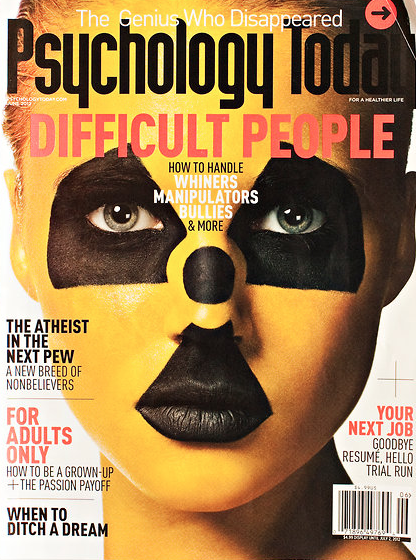
There’s a great article in this month’s Psychology Today magazine penned by Augusten Burroughs. (I’m trying to find a link to the article proper, but it’s resisting thus far.) At first, it seems like a downer: it’s about giving up dreams.

He speaks about reciting a poem for a school performance…and how he knew that it was genius. He was genius. He was an actor that was only seen once in a generation.

And then he saw the video. Without the emotional pull of performing…he saw himself perform.

Augusten Burroughs (“Running With Scissors” and a new book, “This Is How”) thought he was a great actor until he saw himself act on tape. “Thank the Lord Jesus for making video recorders and play-back decks at just exactly the right moment in time. Because I was able to now see myself not in my own mind, but rather with my own eyes. And it was a stunning revelation.” Burroughs refreshingly suggests that sometimes, people are better off letting go of their unrealistic dreams. (from Vera Titunik‘s article for the Times.)

The unvarnished, unsubjective truth that this video showed him? Is that he was, sadly, not the best, most fantastic actor of his generation. (I think he used the word “mannequin.”)

But – and here’s the kicker that sticks with me – the reason behind his wanting to act? The real reason? Was because he wanted to connect with people.

And so he started to write.

(I think we’d agree that he’s a fantastic writer…maybe even a better writer than he might’ve been as an actor.)

But the real nugget of wisdom? Comes in the fact that he figured out what his real purpose was…to connect with people. Once that truth was divined? He just needed to tweak the method…in his case, from acting to writing.

In mine, from singing to administrating.

What’s your true purpose? Are you living it? How can you get there?

Advice?

I’m always asking for advice.

Asking people what’s worked for them, what hasn’t, what their recommendations are is a big part of the ways I gather information. Sure, I filter that info through my own circumstances and personality, and keep those things that ring true…but it’s the gathering, the listening that helps me to inform my choices. It’s one of the parts of the Profile Phriday posts that I enjoy the most…hearing firsthand what has worked for people, and what their suggestions are.

LPC over at Privilege writes about her top requirements for doing a good job here. Her first and last are things that I don’t think about very much…closing. When I was selling pianos (for that fateful, ramen-noodle-nourished year), that was my mantra. Close. The. Deal.

(I was a horrible salesperson.)

But it occurs to me that, even in the arts non-profit world, that I could stand to close a little more often. Not because I’m selling anything (although I am, constantly, when talking to people outside my colleague circle), but because I’m keeping the end goal in my front brain.

What are the small steps you take to do your best?

Kim Pensinger Witman – Constant Collaboration

Kim Pensinger Witman is known nationally for being the driving force behind the Wolf Trap Opera Company, one of the premiere young artist training programs in the U.S. But prior to her operatic life she studied in two different, yet ultimately related, disciplines. Here’s her story.

My transitions weren’t clean, and they were of two types – the first early one, from music therapy to the life of a freelance collaborative pianist; and the second one, from pianist to administrator.

Where did you go to school?

Elizabethtown College, B.S. in Music Therapy

Catholic University of America, M.M. in Piano

What drew you to your chosen degree field?

I identified as a musician from an early age – was active in every single musical thing possible in my childhood, from school choirs and bands to being an organist at my church at age 13. But I had no illusions about my ability to be a professional musician. I didn’t believe I had the chops or the work ethic to sustain all of that private practice time. In looking for a career that might allow me to stay in touch with music and still let me be with other people, I found music therapy. My music therapy professors were wonderful role models, and they reinforced my decision to embrace what was then a particularly new and kind of fringey career path in music. My piano teacher in my undergrad was also a composer, and although he wasn’t an R.M.T., he was heavily involved with the music therapy track at Elizabethtown.

In the early years of our marriage, my husband and I decided we wanted to get M.M. degrees. Just because. We figured we’d have kids fairly soon, and after that, such a pursuit would be unlikely. I really just wanted to immerse myself in the keyboard in a way I hadn’t before – and at 25, I was finally ready to do it. But I didn’t believe it would lead to a career change – I fully expected to continue as a therapist after getting the degree.

During my M.M. degree, I fell into a graduate assistantship in the opera program. (I filled an unexpected vacancy. I only got the job because the program was desperate, and I had a bag of tricks that allowed me to be functional – awesome sight-reading, a love for languages, and the ability to work easily with a range of people.) The decision to move away from therapy into playing the piano for a living was born of curiosity after I finished my degree. I really didn’t know if I had the chops for it but thought I would spend a few years in pursuit and see what happened. So, the first step into my collaborative pianist career was made for me; had the graduate assistantship not opened up unexpectedly, I would not be doing what I’m doing today. Full stop. But the next step – that of independently filling in the gaps in my opera education in the 2 years after my M.M. degree – was a decision I made on my own.

Even though I learned a tremendous amount at Catholic University, it didn’t have a lot to do with my transition to the opera business. Because I was so ill-prepared for my surprise teaching assistantship, I scrambled to stay one step ahead of my students and wasn’t really able to benefit from high level instruction of my own. The biggest influence at CUA was probably my piano teacher Thomas Mastroianni and my chamber music supervisor Robert Newkirk. Dr. Mastroianni saw me through a scary wrist/hand dysfunction (thought to be RSI but ultimately wasn’t) and gave me the confidence to know that if I wanted to make my living at the keyboard, I probably could. And Bob Newkirk presided over my first legit piano trio experiences, cementing a future love of chamber music.


I know lots of people who would agree that any kind of psychology degree is a boon in the performing arts. 🙂 But how did you make that jump from the piano bench to administration?

When my current job opened up in 1997, I was a pianist on staff at Wolf Trap. I didn’t intend to move to an administrative career (was not looking), but over a period of months I fell into it. (I seem to do a lot of falling into things…) The move into administration was a decision I made somewhat reluctantly. When my job opened up, I made no move to pursue it, for I couldn’t imagine taking a desk job. But when it wasn’t immediately filled, I began to think that such a move would allow me to continue to participate in the opera world, open up new creative possibilities, and (probably most importantly) let me move away from the musician schedule into a 9-5 routine during much of the school year so that I could see my kids more. Spending as much time as possible with my family was non-negotiable.

So here I am – currently the Director of Wolf Trap Opera & Classical Programming for the Wolf Trap Foundation for the Performing Arts. Basically, I run an opera company inside a non-opera-specific organization.

How do you self-define?

Initially: I’m a music therapist.

Then: I’m an accompanist. (Well, a collaborative pianist, but such a thing didn’t really exist then.)

Now: I’m an arts administrator.

And simultaneously with all of the above; I’m a musician. (Which has less to do with how I pay my mortgage than how I see the world.)

Ok, speak to us a little bit about that worldview.

This can’t be understated. Everything I learned about people, about the intersection of art and life, had its roots in my study and brief practice of music therapy. I went into that specific field because the abstract study of music felt somehow isolated and irrelevant, and I was only interested in spending a life in music that felt as if it enabled connection with “real life.” (A naïve statement in its frankness, but it was how I felt at the time.) Even now, two career shifts later, my whole approach to the people in this business – the artists, the patrons, the audience – is shaped by those early years of never considering art as being outside of daily life.

And everything I learned and did as a collaborative pianist continues to play into my life as an administrator. It taught me empathy for performers, a respect for the dynamic and nonlinear processes in the rehearsal room, and an appreciation for the high levels of research and preparation it takes to do good work.

What advice would you give to someone struggling with this decision?

Lest any of this seem too tidy, I should mention that while I was a music therapist I was supplementing my income by playing in piano bars and gigging as accompanist for choral societies and theatre groups. While I was a collaborative pianist, I was a church organist/choir director, piano teacher, pit orchestra member, dinner theatre music director, college adjunct faculty and mom. Some of that stuff followed me into my arts admin days but gradually fell by the wayside as the demands of my job increased and my stamina gave out. So be aware that some of the clarity comes with the retelling…

Aside from the obvious (know yourself, be true to yourself, don’t do any of this to please other people), I guess I’d have to caution against black-and-white thinking. This is all so very and so wonderfully gray that it need not be as frightening as you think. I’ve always been terrible at the 5-year/10-year plan thing because it seems so much more legitimate to focus on today’s decisions, next week’s goals, or (at the outside) next season’s dreams. You may be the kind of person who needs to project beyond that in order to move forward. But I believe that it hamstrings us unnecessarily to frame our decisions as part of a linear path in such an extended time horizon.

Life happens.

Plans change.

And this is not always bad.

Be flexible, keep your gaze forward but your feet underneath you, and you’ll know what feels right. And generally, those unexpected things are way better than anything you planned.

And now that I think of it, probably the most important thing is to ignore the voices in your head (or the people outside of it…) who tell you that if you have X years or X thousands of dollars investment in training for a specific career, you have a moral obligation to see it through. If you know it’s not the right path at any point, that’s the time to set a new course. And although the next year or two of transition may be difficult, it’s nothing compared to the desperation you’ll feel if you keep blindly putting one foot in front of the other and end up in a life you hate.

Furthermore, none of what you learned is lost. Seriously. No matter how specific those skills, the only way they’ll go untapped is if you don’t value them.


Tagged , , , , ,