Tag Archives: career changers

Annie Burridge: Soprano and Senior VP

Profile Phridays are back!
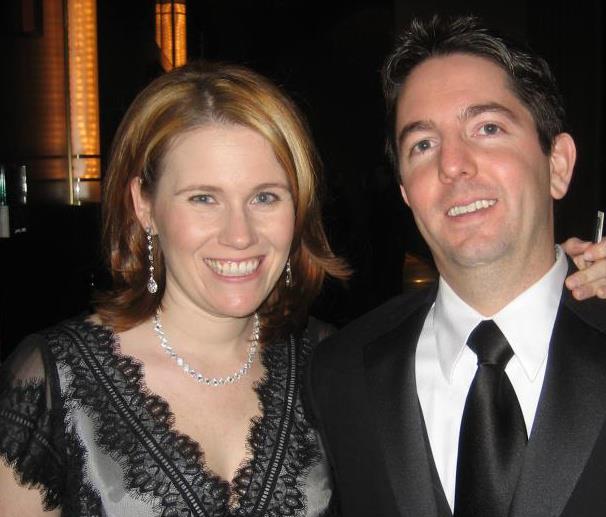
I’m glad to introduce you to Annie Burridge, Senior Vice-President for Institutional Advancement for the Opera Company of Philadelphia. I had a chance to get to know her during the Opera America Leadership Advance, and I think her experiences will resonate with many “reformed singers.” Here’s her story.

How did you get your start?

Technically, my theater career began at age 6, when I was the Littlest Indian in a production of Peter Pan. My mom was a music teacher, and there was always music in our house. I sang all through school, was in musicals and community theater productions. I earned an undergraduate degree from Pennsylvania State University, majoring in Vocal Performance and minoring in Business. (There’s some classic foreshadowing for you, because even though I didn’t really know what Arts Administration was, I thought it sounded interesting.)

I had success and support at Penn State, but didn’t really know whether I was competitive on a larger scale. I did some graduate school auditions, and got a good offer from New England Conservatory. Right before starting the program, all of the incoming students auditioned for a spot in the Opera program, and I was extremely fortunate to be one four sopranos selected. (The entire program was capped somewhere around 25 singers) I worked with John Moriarty, and sang Mrs. Wordsworth in Albert Herring and Cunegonde in Candide. I was really happy with the opportunities that I was given while in school, but found my outside auditions to be a little less successful: I did a pay-to-sing in Salzburg one summer, but didn’t have much luck in the YAP realm until the December after I graduated. Des Moines Metro Opera called on December 23rd: they needed a Gretel for their January Opera Iowa tour, and even though I hadn’t had a live audition for them (I had sent a recording of Zerbinetta’s aria, because they had programmed Ariadne auf Naxos for the summer season), they offered me the role. I did the tour, and stayed on for the summer season. The following spring I did the Pensacola Opera Young Artist program.

It sounds like you were on your way!

Maybe, but it didn’t so much feel like I was on my way. On one hand, I felt incredibly grateful to have those professional opportunities; I learned so much! It was extremely frustrating. I knew that I could tackle difficult repertoire (Lulu, anyone?), but it didn’t seem to matter. It also didn’t matter that I was a good writer, or a natural planner. I rewrote my classroom presentations for the DMMO school tour, but having that eye for strategic planning didn’t make directors more likely to hire me. I had this whole host of talents that simply didn’t transfer over.

Ouch. That’s a hard place to be.

It was. When the Pensacola program finished I went home to Philadelphia – I had met a guy named Paul in between my residencies at DMMO and Pensacola, so I had some incentive. (He’s now my husband.) And I took an administrative job at the University of Pennsylvania to earn some money, as I was just tired of being poor. One of the perks of the job was that I could take classes at Penn for free, so I signed up for a Marketing class in their Non-Profit Administration program. After the first two classes I knew that I had found my thing, and weeks later I was offered my first arts administration position.

Huh! Did you make the decision to change right then?

Yes. It was a big moment for me. I’ve always been someone who commits fully to a career path, and I felt I needed to choose either the administrative career or the singing career – I didn’t want to dilute my impact in either arena by only giving it half my attention. I discussed it with my husband, cried for about an hour, and then made the switch.

Million-dollar question: was it worth it?

I had an epiphany in the car one day shortly after making the switch: I remembered the sitzprobe of Madama Butterfly at Des Moines, and just being moved to tears at the beauty of the music, the complete experience. I remembered sitting alone in the audience during a rehearsal of Barber of Seville in Pensacola when I was covering Rosina, listening to the overture,and again being moved to tears that opera was my job. And I realized that the moments that stuck with me the most weren’t moments in which I was actually singing. It was a revelation. So short answer? Indeed it was worth it. I call on the experiences that I had as a singer daily in my current position (Ed.: Annie oversees all the development and marketing efforts for OCP.) – my knowledge of the industry and passion for the art form allows me to inspire the people with whom I work and interact. I also feel so much more ownership in my current role at OCP than I did as a singer. I can watch a rehearsal and know that my efforts made a huge portion of this production happen. My traction with donors and the financial health of the organization dictates that I am part of the artistic process. Granted, if it were up to my personal preferences we’d be doing all Britten, all the time! But I enjoy being the person who represents our stakeholders and larger community in those discussions. And finally, those skills that I felt were underutilized when I was singing – writing, planning – I’m using every day.

It’s rear-view mirror time: What advice would you give to someone who is struggling through a dilemma similar to your post-Pensacola frustrations?

Be honest with what you want your life to look like. I was lucky in that I had some blazing arrows pointing me to my place in the industry, but I still have pals who are struggling through these decisions.Think about what you want your life to look like 5, 10, even 20 years down the road. What’s your ultimate goal? How can you pick up the skills that will get you there? Some people need to remain close to the creative process, so they might opt for teaching over an administrative job. Some may want to cobble five or six different kinds of performing jobs into a career. I knew that I wanted to be involved at the highest level of artmaking, and it became clear to me that I wasn’t going to be able to reach that level as a singer. I wanted to be a part of the biggest game in town, and I wanted to be a big part of it.

I think you’ve made it! Do you have any parting words or wisdom?

My boss’ motto is to be nice to everyone, all the time. It’s a small industry, and once you build those relationships you’ll have a network of people to ask for advice and help…because soon that assistant will be running the program for which you’ve dreamed of working. It always pays to be nice.
Tagged , , , , , , , ,

Age of Reform

ImageKurt Ellenberger wrote a thoughtful article for the Huffington Post about the arts and higher education. In it, he talks about the ways in which college music programs prepare students for a field that is shrinking, and doing so using models that are based on the artistic realities of the 1950-70s. Key faculty are charged to recruit, to provide the economic engine that will power the educational train: but, with undergraduate degrees costing near 50k, graduate degrees close to if not more, it’s a lot to spend for a career with no clear path to employment at the end of the journey. I’d agree with him that we need to rework the system a bit.

I remember talking with one smart, savvy singer a few years ago…he was frustrated at the lack of a clear path, and remarked “My buddies who are going to law school know how long they’ll be in school, how much it’ll cost, what they can expect to earn when they get out. I’m going to have close to the same amount of training in my field as they will in theirs, but I may not even be able to make an honest living.”

He was frustrated, and rightly so. There are very few guarantees in our current economic climate, but among artists they number even fewer. One could place the blame on the academic institutions, for taking students who obviously couldn’t make the grade. But, as someone who auditions a fair number of undergraduate singers every year, I can say that the rates of change in a young voice can be both profound and quicksilver: even during the small window between their autumn audition and their arrival in late spring for rehearsals a Studio Artist can sound – for better or worse – like an entirely different animal. 

So, how to reform this model that obviously doesn’t work? Mr. Ellenberger talks about diversifying: finding the things that make each program special and capitalizing on those key elements. You can likely pull the names of schools who have done this off of the top of your head: Berklee for jazz, Juilliard for classical music: Rice in Houston has a reputation for singers with strong technique, University of Maryland for skilled singing actors. (There are many more…but there are also many programs whose strengths are not clearly defined.)

I think it’s a step in the right direction. Rigorous coursework, one-on-one mentoring and quality performance opportunities are still the building blocks to strong, vibrant musicians, regardless of discipline. But I’d also, in this age of specialization, call for two other aspects that should be mandatory in that education:

  1. Exposure to professionals in related fields, or professionals with that same undergraduate degree who have transitioned into something different. A panel, once or twice a year with a group of people who sat in the students’ places, but have found a non-traditional way to use the knowledge that they gained. 
  2. Cuts. (Controversial, no doubt.) Being asked after a number of semesters to rethink your choice of a degree if your teachers see you struggling with the coursework/physical demands/lifestyle is not a bad thing. (Although at the time I think it probably can feel very much like one.) To have a group of people that know you give you honest feedback and offer you options? It seems like a very responsible kind of guidance. And also, to know you have to dig in to succeed, to stay in the program? (Or to ultimately prove them wrong?) Well, taking that responsibility upon one’s own shoulders can be empowering.

Thoughts? Put on your arts education reformer’s cap, and tell me what you’d recommend.

Tagged , , , , , , , , , , ,

A Framework for Creative Change

There’s a lot of buzz out there about the creative class… those people, regardless of industry (and while I might take some serious flak for it, I am of the opinion that not every person pursuing a performance degree/career is, in fact, creative. But that’s a topic for another post.) are innovators. In his book The Rise of the Creative Class, Richard Florida states that “access to talented and creative people is to modern business what access to coal and iron ore was to steel-making.”


That quote is 10 years old, my friends.


Adobe did a research study on UK workers, which showed that most people – fully two-thirds of those surveyed – felt that they were not living up to their potential. To quote Dylan Jones-Evans (Western Mail, 7.14.12)

“Four out of five believe that there is an increased pressure in work on being productive rather than creative. In addition, risk aversion is seen as a barrier with “playing it safe” being the strategy usually adopted by organisations which results in those who are innovative and entrepreneurial having their ideas stifled by those who are less creative. They also feel there was a lack of time to create new things and that they cannot afford to be creative.”


Hello, US Classical Music Market.


We’re seeing the big 10 operatic warhorses in heavy rotation. We’re seeing young artists inhabiting the roles usually given to established singers. We’re seeing a heck of a lot of Mozart, Beethoven, Brahms on chamber music programs. Companies are cutting back, scaling back, folding. Audiences are aging and shrinking. In terms of building a younger audience? We are the 98-pound-weakling trying to woo the quarterback’s girlfriend. (She’s mostly not giving us the time of day, but we’re not giving up yet.)


How much of that, I wonder, has to do with an art form in serious transition? In its heyday, having season tickets to the opera was akin to what having season football tickets are today. (singers/athletes; audiences; financial models and arenas…the sports analogies are really endless.) But that nostalgic glow is only attractive for a small margin of the population; those folks who are in a position to donate, to keep small companies afloat and to shore up the finances of larger ones.


It’s a difficult time to be an artist. (although, let’s be frank…has it ever been easy? I mean, we all know how Bohéme goes, right?)


In the current climate, it’s only natural to harbor some doubt… there’s some serious math to be done, weighing passion against sacrifice, talent and preparation against the national field. Personal preferences can take a backseat to financial necessity.


What if you’re the one playing it safe? With a desk job and a 401k and a nice apartment? And a constant headache and difficulty getting out of bed in the morning and the tendency to self-medicate because you’re just somehow not feeling it?


The Harvard Business Review has some advice. As a former (reformed?) teacher, there’s something inherently less scary/more doable when imagining a career leap as a curriculum or night course…setting up an experiment, finding ways to gather more information, sticking to a timetable rather than experimenting endlessly. (That’s called ‘having hobbies.’)


What scares you the most about making that transition?


Tagged , , , , , , , ,

Common Sense, Illustrated.

I’m a huge fan of  Jessica Hagy, the author of Indexed. She has a new graphic up at Forbes.com called 20 Ways to Find Your Calling. And, in her beautifully succinct manner she defines steps to becoming an adult. (My favorite is obviously #3. (“Say yes to odd opportunities.”)

(Isn’t that how I got myself into this mess in the first place? Indeed, I think, happily, it was.)

Tagged , , , , , , , , ,

Clarity, of a professional persuasion

I had a conversation a few weeks ago with a pal, and it made me realize that I should maybe clarify a few points about this little project of mine.

This space is, at its best, meant to be a place to share encouragement and tales of career-shifting for folks who started out their careers intending to pursue the arts.

There are lots of people who persevered in following their dream, and have attained that initial goal – I am continually in awe of those folks. (The aforementioned pal is a model of quiet focus and creativity, and has built a significant career on the strength of her artistic talents. She’s the bomb.)

I didn’t have that kind of clarity as a student. I wanted to be a Jack-of-all-Trades (but highly successful at everything I tried, naturally…ah, youth.), and college made me aware of a multitude of different goals rather than focusing my attention on a single goal.

But to all of you, my pals and acquaintances who are making lives as performers and art-makers, we’re proud of you – I’M proud of you. Your success in this crazy field, in this even-crazier economy is really something to crow about. And I know that many of you have been asked to talk about the how-to of your careers with students at the outsets of theirs – “How did you get from point A to point B? How much did you have to practice? How long did it take to get your first break? Is it all luck? Should I throw in the towel before I start?”

It was difficult for me to find people to whom I could ask those questions, mostly because it took me a while to figure out what I wanted to be when I grew up (Honestly, I’m still not 100% sure; but I’m pretty durn happy where I am.), and because I knew that I wasn’t going to be a performer long before I acknowledged it publicly.

So, through examining other folks’ winding career paths, I am hoping to acknowledge two things:

  1. That, even though I’m not performing, I consider myself a successful adult. It took me a while to figure it out, but I’m better for doing it, and ultimately happy.
  2. That my arts training – 80% of it – I still use, in various ways, every day. Organization, collaborative skills, public speaking…and in my case, a lot of the musical skills/knowledge, too.

The point is to reframe how those of us who are not primarily performing/art making define success, how we keep our hand in, and to celebrate the haphazard paths that make our lives richer for the detours.

20120622-174345.jpg

Tagged , ,

Celebrate the Mess!

I am such a fan of people’s stories.

A huge fan. And not just of the final product, but of the whole ongoing process: the passion, the struggles, the discernment, the adventure of a new path, the satisfaction of recommitting to a routine or activity that brings comfort. But I’m finding that folks often apologize for the process…for leaving their original passion, for floundering before finding the new avenue.

Quite frankly? Those messy moments are so very telling. I am also a HUGE fan of those creative messes.

I remember being called into a meeting at my HVAC job, where my bosses quite generously offered me an opportunity to advance to their sales team. I had no real knowledge of the business, had a limited background in the science and technology behind the product, and while I enjoyed the office and the challenge of educating myself about widgets and airflow and humidity (and also learning to RTFM) I was pretty sure that I didn’t belong there. But I really didn’t know what I wanted to do…so I stammered my way out of the meeting, letting them know how flattered I was to be considered. I slept on it, and shortly thereafter tendered my resignation to finish my teaching certificate.

It was a messy situation, a snap decision, but ultimately it was the right thing.

Do I regret my widget days? Not at all – I learned how to function in a linear, masculine office, figure things out on my own before asking (and to also not be ashamed when I needed to ask), and speak my mind plainly and clearly. But I also didn’t realize that my (wholly unformed)dreams didn’t jive with my circumstance until my bosses showed a willingness to invest in me.  It was a catalyst, a get-off-your-butt-and-make-a-choice moment.

I’ve referenced Danielle LaPorte before, but this posting is a theme that I think bears repeating:

You don’t need to burn the dock to push off your boat.

You don’t need to dis’ how you’ve done things in order to do things differently.

There’s no need to criticize the past to validate the future.

But we do.

She goes on to say that honoring the path that got us to -or even past – the messy part is a vital part of our own story. And I would heartily agree.

Celebrate the mess, my friends!

Tagged , , , , , ,

Reading List: One Person/Multiple Careers

My friend Claire (she is my new go-to for great books – her mom is a librarian, and she’s supremely well-read.) turned me on to Marci Alboher‘s book One Person/Multiple Careers: A New Model for Work/Life Success.

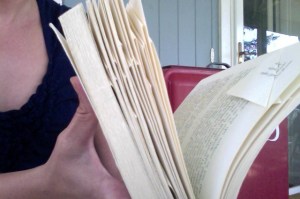
Now, I’m not usually a highlighter of books: when I find something interesting, I’ll either stick a piece of paper (gas receipt, junk mail, business cards…even twist-ties and rubber band serve on occasion) in the pages of a hardcover, or, if the book is mine and a paperback, I’ll dog-ear the page. (Book purists, I apologize.) So I took the book to the gym, to motor through some reading while on the elliptical.

Here’s what the poor, poor book looked like after an hour:

You can tell that I’m finding a lot of value in this particular tome. I’m tempted to just copy all of the bits and pieces that ring true to me, but we’d be here all bloomin’ day.

The most liberating takeaway is one that flies in direct opposition to what many of us have been taught: the concept that we don’t actually need to specialize for a lifetime in one discipline and ignore everything else that we enjoy in order to find success. For some people there are parallel tracks; others commit to a discipline for a number of months/years, and then either leverage that knowledge or skill set into a different career or turn that single-minded focus towards another discipline that they’re interested in. But all of the permutations are valid, and frankly very interesting. And it’s not much of a surprise to see a high number of artists and musicians’ stories represented within the pages.

There are strategies for finding your ‘slash’ (or, rather ‘slashes’ – why stop at one?), interspersed with real-life case studies of folks who have successfully explored both parallel and sequential tracks.

It’s worth the read, I promise! (And thanks, Claire, for the recommendation!)

Tagged , , , , , , , , ,

Career Scaffolding

Rather than posting a personal profile this week, I’d like to direct you towards a post on Creative Infrastructure by Linda Essig, the director of ASU’s Arts Entrepreneurship Program.

(Side note – Arts Entrepreneurship? How awesome is that? While the 17-year-old-Me might’ve been all about performing, the [mumblemumble]-something Me is totally entranced by this program of study.)

She writes, in reference to a chance meeting with an arts worker in a metropolitan sushi bar:

The story of J is a good example of a person who uses his talents, skill and training in the arts to build a career, albeit not one he would have envisioned as an art student. Students enter study in the arts with many dreams and aspirations. […] If J had kept his head down, looking only toward the world of studios and gallery shows, he might not have seen the opportunities that have led to what became an enjoyable and sustainable career.

I can vouch for the undergraduate nearsightedness, and also for the value in keeping one’s eyes open to opportunities. If we think about our undergraduate (and, in some cases, advanced studies) as the scaffolding upon which we build a career, rather than the than the gun barrel through which we cast our aspirations, it free us up to look in any number of directions. Sometimes the straightest, most direct route is simply the easiest route, and not the best. Maybe we should co-opt Lysander’s words of wisdom for this little corner of the internet:

The course of true love ne’er did run smooth.

Amen…whether in love, or relationships or vocation or avocation…sometimes those crunchy places are trying to catch our attention. Listen. Look around, lean into those bumpy, rocky spaces.

Tagged , , , , , , , , , ,

Daydreaming

I’ve been searching for and, happily, finding great resources for creatives looking for their next step. There are so many interesting articles and points of view! But at this point it feels a little like my head is a very vast space (I’m stuck on the image of a train station…Union Station in DC, or perhaps Philly’s 30th Street Station…something with lots of marble), filled with many people…there are fragments of ideas bouncing off of the walls, careening into other thoughts, dashing some into pieces and integrating others into a larger, more complex idea. It’s part rock concert, part flea market, part art exhibition, part carnival.

Here are some contributors to my mental cacophony:

I’ve been reading her blog for a while now, but I’ve just picked up Danielle LaPorte’s book, The Fire Starter Sessions.

And I’ve been spending time reading the Communicatrix, who has coincidentally just reviewed Chris Guillebeau‘s (you read him, right?) new book The $100 Startup.

These folks are smart and courageous. They write like they’re speaking to a friend. Some of it’s inspiration…some is tough love…and some are case studies, examples of how others have opted into or out of places and spaces.I have to say that there’s never been a better time to rethink yourself, your path. These are brave, eloquent people who have found unconventional success…and moreover, have defined that loaded word “success” in their own way. I like to think of having one of them on my shoulder, to provide perspective when my inner demons are telling me that I’m not good/smart/kind/industrious enough to amount to much.

But the first thing that I’m seeing in all of these folk’s philosophies? Is that they daydream. They practice cultivating those crazy, out-of-the-box thoughts…much like we practiced auditioning. Daily. Specifically. Focused. They allow themselves to daydream, without a censor telling them that they can’t, shouldn’t, will-never-be-able-to.

They’ve allowed themselves to think about those things that they want…without putting the onus of merit on their dreams. Let’s remove from the equation for just a moment whether you feel you deserve something, or all of the things, or nothing at all. And let’s just go with the thought that someone thinks that you deserve to dream.

(Heck, I think you deserve to dream! Add one person to your mental cheerleader list.)

Now, from that empty place? Dream.

What do you want? How do you want to feel? No judgements. Nothing is too vast or too shallow – it’s dreaming.

I want the metabolism of a 20-year-old; I also want the wisdom and smarts of someone older and wiser and smarter than I. I want respect. I want inner peace. I want to be able to hold my liquor. I want people to love being around me. I want to be on Oprah someday. I want to write a book. I want children. I want to give my friends and family stories and songs to remember me by. I want to stand up for myself more often. I want a big-girl purse. I want to be able to shave my knees and ankles without bloodying them. I want to write letters in longhand. I want to be more creative.

(There’s my top-of-my-head, all of the things I can type in two minutes, daydream list. I could go on. I bet you could too.)

My challenge to you is to take 5 minutes, create a google doc or grab a notebook or send yourself a voicemail. And daydream about the things you want. Do it every day for 7 days. Think of it as getting yourself into the practice room…for your next chapter.

Let’s check back in here next week and see what we come up with…shall we?

Tagged , , , , , , , , , , , , ,

Kim Pensinger Witman – Constant Collaboration

Kim Pensinger Witman is known nationally for being the driving force behind the Wolf Trap Opera Company, one of the premiere young artist training programs in the U.S. But prior to her operatic life she studied in two different, yet ultimately related, disciplines. Here’s her story.

My transitions weren’t clean, and they were of two types – the first early one, from music therapy to the life of a freelance collaborative pianist; and the second one, from pianist to administrator.

Where did you go to school?

Elizabethtown College, B.S. in Music Therapy

Catholic University of America, M.M. in Piano

What drew you to your chosen degree field?

I identified as a musician from an early age – was active in every single musical thing possible in my childhood, from school choirs and bands to being an organist at my church at age 13. But I had no illusions about my ability to be a professional musician. I didn’t believe I had the chops or the work ethic to sustain all of that private practice time. In looking for a career that might allow me to stay in touch with music and still let me be with other people, I found music therapy. My music therapy professors were wonderful role models, and they reinforced my decision to embrace what was then a particularly new and kind of fringey career path in music. My piano teacher in my undergrad was also a composer, and although he wasn’t an R.M.T., he was heavily involved with the music therapy track at Elizabethtown.

In the early years of our marriage, my husband and I decided we wanted to get M.M. degrees. Just because. We figured we’d have kids fairly soon, and after that, such a pursuit would be unlikely. I really just wanted to immerse myself in the keyboard in a way I hadn’t before – and at 25, I was finally ready to do it. But I didn’t believe it would lead to a career change – I fully expected to continue as a therapist after getting the degree.

During my M.M. degree, I fell into a graduate assistantship in the opera program. (I filled an unexpected vacancy. I only got the job because the program was desperate, and I had a bag of tricks that allowed me to be functional – awesome sight-reading, a love for languages, and the ability to work easily with a range of people.) The decision to move away from therapy into playing the piano for a living was born of curiosity after I finished my degree. I really didn’t know if I had the chops for it but thought I would spend a few years in pursuit and see what happened. So, the first step into my collaborative pianist career was made for me; had the graduate assistantship not opened up unexpectedly, I would not be doing what I’m doing today. Full stop. But the next step – that of independently filling in the gaps in my opera education in the 2 years after my M.M. degree – was a decision I made on my own.

Even though I learned a tremendous amount at Catholic University, it didn’t have a lot to do with my transition to the opera business. Because I was so ill-prepared for my surprise teaching assistantship, I scrambled to stay one step ahead of my students and wasn’t really able to benefit from high level instruction of my own. The biggest influence at CUA was probably my piano teacher Thomas Mastroianni and my chamber music supervisor Robert Newkirk. Dr. Mastroianni saw me through a scary wrist/hand dysfunction (thought to be RSI but ultimately wasn’t) and gave me the confidence to know that if I wanted to make my living at the keyboard, I probably could. And Bob Newkirk presided over my first legit piano trio experiences, cementing a future love of chamber music.


I know lots of people who would agree that any kind of psychology degree is a boon in the performing arts. 🙂 But how did you make that jump from the piano bench to administration?

When my current job opened up in 1997, I was a pianist on staff at Wolf Trap. I didn’t intend to move to an administrative career (was not looking), but over a period of months I fell into it. (I seem to do a lot of falling into things…) The move into administration was a decision I made somewhat reluctantly. When my job opened up, I made no move to pursue it, for I couldn’t imagine taking a desk job. But when it wasn’t immediately filled, I began to think that such a move would allow me to continue to participate in the opera world, open up new creative possibilities, and (probably most importantly) let me move away from the musician schedule into a 9-5 routine during much of the school year so that I could see my kids more. Spending as much time as possible with my family was non-negotiable.

So here I am – currently the Director of Wolf Trap Opera & Classical Programming for the Wolf Trap Foundation for the Performing Arts. Basically, I run an opera company inside a non-opera-specific organization.

How do you self-define?

Initially: I’m a music therapist.

Then: I’m an accompanist. (Well, a collaborative pianist, but such a thing didn’t really exist then.)

Now: I’m an arts administrator.

And simultaneously with all of the above; I’m a musician. (Which has less to do with how I pay my mortgage than how I see the world.)

Ok, speak to us a little bit about that worldview.

This can’t be understated. Everything I learned about people, about the intersection of art and life, had its roots in my study and brief practice of music therapy. I went into that specific field because the abstract study of music felt somehow isolated and irrelevant, and I was only interested in spending a life in music that felt as if it enabled connection with “real life.” (A naïve statement in its frankness, but it was how I felt at the time.) Even now, two career shifts later, my whole approach to the people in this business – the artists, the patrons, the audience – is shaped by those early years of never considering art as being outside of daily life.

And everything I learned and did as a collaborative pianist continues to play into my life as an administrator. It taught me empathy for performers, a respect for the dynamic and nonlinear processes in the rehearsal room, and an appreciation for the high levels of research and preparation it takes to do good work.

What advice would you give to someone struggling with this decision?

Lest any of this seem too tidy, I should mention that while I was a music therapist I was supplementing my income by playing in piano bars and gigging as accompanist for choral societies and theatre groups. While I was a collaborative pianist, I was a church organist/choir director, piano teacher, pit orchestra member, dinner theatre music director, college adjunct faculty and mom. Some of that stuff followed me into my arts admin days but gradually fell by the wayside as the demands of my job increased and my stamina gave out. So be aware that some of the clarity comes with the retelling…

Aside from the obvious (know yourself, be true to yourself, don’t do any of this to please other people), I guess I’d have to caution against black-and-white thinking. This is all so very and so wonderfully gray that it need not be as frightening as you think. I’ve always been terrible at the 5-year/10-year plan thing because it seems so much more legitimate to focus on today’s decisions, next week’s goals, or (at the outside) next season’s dreams. You may be the kind of person who needs to project beyond that in order to move forward. But I believe that it hamstrings us unnecessarily to frame our decisions as part of a linear path in such an extended time horizon.

Life happens.

Plans change.

And this is not always bad.

Be flexible, keep your gaze forward but your feet underneath you, and you’ll know what feels right. And generally, those unexpected things are way better than anything you planned.

And now that I think of it, probably the most important thing is to ignore the voices in your head (or the people outside of it…) who tell you that if you have X years or X thousands of dollars investment in training for a specific career, you have a moral obligation to see it through. If you know it’s not the right path at any point, that’s the time to set a new course. And although the next year or two of transition may be difficult, it’s nothing compared to the desperation you’ll feel if you keep blindly putting one foot in front of the other and end up in a life you hate.

Furthermore, none of what you learned is lost. Seriously. No matter how specific those skills, the only way they’ll go untapped is if you don’t value them.


Tagged , , , , ,